Nav Menu (Do Not Edit Here!)

Home     About     Contact

16 April 2022

Refugees are welcome in Denmark after all

Note:
This blog is migrating to a new website—markperrino.com—and this is the last post that will appear on this site. Please visit the blog at the new site and subscribe at this address: markperrino.com/blog/


Refugees are welcome in Denmark after all

Refugees welcome here! Denmark has announced that it expects an influx of up to 100,000 Ukrainian refugees. That’s an enormous increase for a country whose immigration minister said in January that he was pleased there were only 2,095 applications for asylum in 2021.

Ukrainians in Poland boarding a bus to Denmark. Photo: Paw Lindegaard Nielsen © DR.

Denmark has not taken in more than 4,000 refugees in any year since the migration wave from the war in Syria in 2015, when the country received 21,000 asylum applications. Estimates of the number of arrivals range from 20,000 to 30,000. Minister of the Interior Kaare Dybvad Bek expects that it could exceed 40,000 after Easter vacation.

Emergency residency law

Last month Parliament passed a special law to enable Ukrainians to get residency and work permits quickly. It waives the normal limit on residency of 90 days without a visa or an asylum claim, and the Ukrainians thus need not be part of the asylum system. They will also be exempt from the country’s infamous “jewelry law” from 2016, which allowed authorities to confiscate valuables from refugees but perhaps has never been enforced.

The effort will be expensive. It has cost DKK 2 billion so far. Most of these funds have been taken from the government’s foreign aid budget, a tactic that not all parties are happy with. If up to 100,000 refugees come to Denmark, it will cost DKK 8-10 billion per year (DK). Like the rest of the world’s nations, Denmark has already seen its public budget balloon during the pandemic of the past two years. The logistics of the accommodations will also be difficult; there aren’t enough facilities to house a fraction of the number expected. There are also questions about equal treatment and priorities.

Ethnic favoritism?

One might well wonder why the country is so eager to take in Ukrainians when it has been tightening its asylum and immigration regulations for several years. “A series of clever decisions have been made which have continually ensured better control of immigration,” said Immigration Minister Mattias Tesfaye about the decline in asylum applications.

The Social Democratic administration has been criticized by its European counterparts as well as Danish immigration activists for revoking asylum status for Syrian refugees while the situation in Syria remained unstable. Some critics call the difference in policy racist. Is it owing to the fact that Ukrainians are white and Christian, unlike many refugees and migrants from the Middle East, North Africa, and Afghanistan? At a protest demonstration (DK) held on 2 April before the Ministry of Immigration and Integration, a spokesman for the Syrian Refugees in Denmark demanded that all refugees be treated according to the new residency law for Ukrainians.

European solidarity

Testfaye stated that Denmark’s response is appropriate when “a European country is attacked, a country close to us.” Prime Minister Mette Frederiksen also argued that the situation is different “because Ukraine is our region.… It’s our back yard, if you like.” Pia Olsen Dyhr, the chair of the left-leaning Socialist People’s Party, concurred, asserting mistakenly that “there’s only one country between us and Ukraine, and that’s Poland.” Even the parties that have been most opposed to immigration are ready to welcome Ukrainians, like the others justifying the decision by the concept of nærområde (“nearby area”) and denying that religion plays any role.

The Danish public seems to agree with the view that Ukrainians share European cultural values as exemplified by their interest in joining the EU and NATO and will therefore be easier to integrate. It doesn’t hurt either that they are used to working and that Denmark is experiencing a labor shortage. There have been some difficulties getting refugees from non-Western countries into the labor force.

Inger Støjberg, the former immigration minister who was impeached for abusing her office, disavows the prevailing rationale: “No one dares to say it like it is: It's because the Ukrainians are more like us and because they are primarily Christians."

Now where to put them?

Housing the refugees will be the responsibility of the municipalities. The distribution of refugees (DK) among them depends on how many immigrants from non-Western countries the municipalities already have. Those with many such immigrants will get no Ukrainians. The municipalities where refugees have arrived are scrambling to find accommodations. They use public housing, dormitories, facilities that were set up for Covid-19 isolation, and sports complexes.

Copenhagen Municipality, which has by far the largest number of refugees and has a perennial shortage of low-income housing, is considering building a “pavilion-city” that would house 330 refugees (DK) for three years and include a day-care center. Critics warn against isolating the Ukrainians in another “parallel society.”

Private citizens are also encouraged to take refugees into their homes. They are eligible for compensation of up to DKK 500 ($75) per day, but they receive much less than that. Although the funding comes from the state, it must be administered by the individual municipalities, which set the rates and rules. Some of them hesitate to use the funds at all because the program is difficult to manage and control. Some private citizens who share their homes (DK) with refugees are already becoming impatient with the strain and are asking the municipalities for more help.

Children and accidental guest workers

Housing isn’t the only logistical issue. After the first wave, the residence permit application system became overloaded. People could not get appointments at three of the four regional Citizens’ Services offices, and new offices needed to be set up.

There will be great pressure on schools and day-care institutions. Education Minister Pernille Rosenkrantz-Theil is calling for retired teachers and day-care staff (DK) as well as students in relevant programs to assist with the influx. Student associations from the country’s seminaries have expressed a willingness to help. The schools will need to set up special tracks with native-language instruction and recruit Ukrainian teachers and others to staff them.

Filling job vacancies with Ukrainian refugees won’t be a simple matter either. Because of Ukraine’s conscription policy, most of the refugees are women and children. Ukrainian women have been part of the labor force, but it can take time to place them in suitable positions, warns Mads Lundby Hansen from the CEPOS think tank. The benefits for the Danish economy would come over the longer term, he adds, and the Ukrainian ambassador says that Denmark shouldn’t create conditions for Ukrainians to stay here for the rest of their lives. Even if they don’t, perhaps the country should remain prepared for additional surges of refugees in the new global disorder. 

05 April 2022

The Putin Referendum & important announcement

Note:
This blog is migrating to a new website—markperrino.com—and will soon stop publication on this site. Please visit the blog at the new site and subscribe at this address: markperrino.com/blog/


The Putin Referendum

Like other European nations, Denmark is supporting Ukraine in its defense against the Russian invasion. It is imposing sanctions, and many companies have stopped Russian operations and trade. It has sent humanitarian and military aid. It is increasing military spending (DK) to 2 percent of GDP, in accordance with NATO policy (albeit slowly—by 2033). It has assented to NATO’s request that it send troops to Latvia. It has agreed to accept 100,000 refugees, a huge increase from the normal level.


Royal Life Guards. Photo by Nick Karvounis on Unsplash

None of these moves has been very controversial. They are backed up by almost all the parliamentary parties and the public. But the Social Democratic administration has also scheduled a referendum on the country’s opt-out from the European Union’s defense program, and this is more problematic. Denmark has rejected four areas of EU collaboration: defense, justice, the euro, and EU citizenship. Danish sentiment for EU membership was conditional upon maintaining this measure of independence. 

What defense collaboration?

The opt-out means that Denmark doesn’t participate in EU defense operations and related aspects of EU foreign policy and security policy. But there has never been an EU army. Any decision on a joint military operation requires unanimous approval, and the individual nations can decide whether to send troops. The opt-out hasn’t received much attention since the Edinburgh Agreement in 1993, and the referendum is controversial for a few reasons.

It is of course opposed by factions that have been against EU membership all along. It also appears to be a hasty reaction to a particular event—Russia’s aggression—rather than a thorough consideration of Denmark’s role in the EU in general. And there is also much uncertainty about what European defense collaboration would entail in concrete terms.

Can Europe count on NATO?

Since World War II, Europe’s defense has been provided by NATO and the United States. Denmark was a founding member of NATO and a loyal follower of US-led military campaigns in Iraq, Afghanistan, and elsewhere. The EU’s collective military does not seem to offer anything beyond NATO’s capabilities. But when Trump trash-talked NATO, some European leaders spoke of Europe’s needing to end its military dependence on the US. Biden has reasserted the US commitment to European security, and NATO has revived since the attack on Ukraine. But there’s no guarantee after the 2024 American election.

The initial opinion poll (DK) on the referendum showed 38 percent in favor of ending the opt-out, 23 percent opposed, and 32 percent undecided. A large majority of Parliament supports it. But the opposition within the administration’s own governing coalition has objected to the formulation of the referendum question (DK), which reads “Do you vote yes or no on whether Denmark can participate in European collaboration on security and defense?”

Voter manipulation

Peter Hvelplund, chair of the Red-Green Party’s parliamentary group, says the phrasing is misleading and “direct cheating.” He prefers that the issue is formulated thus: “Do you want to abandon the defense opt-out?” The new leader of the Danish People’s Party, Morten Messerschmidt, is also convinced that the formulation was intended to frame the issue to favor passage.

The utopian solution

This dissent was no surprise since the platform of the Red-Green Party, whose members still include some diehards from the old DKP (Danmarks Kommunistiske Parti), calls for Denmark to withdraw from NATO (DK) and disband the military. The steering committee’s re-affirmation of this position as recently as March 6 made it difficult for the party chair, Mai Willadsen, to persuade the media (DK) that the party didn’t really want to leave NATO just yet but rather only when conditions in the world make the desertion more practical. 

In early February, during the Russian build-up on the Ukrainian border, the administration announced that it was opening discussions on allowing US troops and military equipment to be stationed in Denmark, as they are in several other NATO countries. The Red-Green Party and the Socialist People’s Party, on whose support the administration also depends, oppose this development (DK) as well. If this bickering is all too predictable, you can watch Danish politicians contending with nothing less than the US, Russia, and China all at once by tuning in to the new season of the Danish Broadcasting Corporation’s dramatic series Borgen.


28 January 2022

Oops!

Dear Subscribers,

You may have received a strange blog post from here yesterday - a bundle of four posts from 2020.

Sorry for the inconvenience and confusion. I have no idea why it was sent.

I'm preparing to move the blog to a new website - and to resume posting

I was in the system yesterday to download the archives, and something must have triggered the email.

I will send an announcement from here when the new site is up and running, including a link to the new blog address and subscription service if the subscriptions aren't transferred automatically.

I look forward to returning to action. Thanks for your patience.

Mark 

10 September 2021

End-of-summer news roundup (cont’d): Progessive segregation

Copenhagen hosted the WorldPride festival (DK) last month. The rainbow flag and colors were on display everywhere. The final collective parade was canceled because of Covid, but there were six smaller parades that met in Fælledparken, the city’s largest park. The Nørrebro Pride section attracted special attention because of the strict entrance requirements for its opening party: No whites or heterosexuals allowed; nobody with a hairstyle stolen from another culture either. About the policy, which sported a new acronym - QTIBIPOC - one puzzled observer asked, “Isn’t it illegal to exclude people on the basis of their sexuality and skin color?” Lars Henriksen, spokesperson for the official Copenhagen Pride, thought the policy was “super positive… It’s brilliant that some separatist spaces are created…. Some people feel insecure in what we’re doing.” 


Nørrebro Pride: Photo: Ólafur Steinar Rye Gestsson © Ritzau Scanpix.

Global citizen or authoritarian fellow traveler?

After winning the Olympic gold medal in badminton in a convincing drubbing of defending champion Yu Qi Shi, Viktor Axelsen broke into delirious tears of joy, prompting journalists and social media commentators to wax rhapsodic about the sight of a man crying in public. A couple of weeks later, Axelsen decided to move to Dubai (DK) because of its better training conditions. The Danish badminton organization was disappointed, and others note that the oil states like to use Western athletes for PR and asked Axelsen whether the Emirate’s Sharia legal system bothered him. He acknowledged the "shitstorm," maintaining that he’s become less concerned with what people outside his inner circle think of him.

Did you take communion from this guy?

Denmark isn't immune from the grisly sort of domestic terror that graces Anglo tabloids. “A Danish parish priest confesses to murdering wife and dissolving body in acid," reports The Local. Inspired by an episode of Breaking Bad, Thomas Gotthard attempted to get rid of his wife’s body in a feed barrel at an abandoned country estate. The barrel was too heavy to move, so he divided its contents into two smaller barrels, buried them, dug them up again, chopped the body into smaller pieces, and burned them. The police found hydrochloric acid and caustic soda in Gotthard’s house, along with suspicious google searches on his computer. “I have sent my life out into the darkness where I want to stay,” he said. “No one should feel sorry for me.”

Family values gone wrong

The Danish Supreme Court sustained a ban on the criminal gang Loyal to Familia (DK). The Court concurred that the gang was a citizens’ association and that its ordinary activities included the commission of wide-ranging and serious criminality. Citizens’ associations (foreninger), which are very common in Denmark, are protected by the Constitution. This was the first case against an association in almost 100 years and the first time a criminal gang has been declared illegal. LTF, which arose in the Nørrebro district in Copenhagen, was banned by the police in 2017 after a series of shootings, and there are still estimated to be around 100 members in its seven chapters in the country. The police do not expect the gang to suddenly stop its business but are encouraged that they have greater opportunities to prosecute its members. Prosecutors were encouraged to bring similar cases against other criminal gangs.


03 September 2021

Summer news roundup: Mermaid cage fight

The New York Times reports that the estate of Edvard Eriksen, the sculptor who created the famous Little Mermaid that sits on her haunches in Langelinie Harbor – one of Copenhagen's biggest tourist draws – is suing the village of Asaa in northern Jutland for displaying another version of the Hans Christian Andersen figure. The heirs of the original sculptor not only demand compensation but insist that the “copy” be destroyed.

The original scuplture was a gift to the city of Copenhagen in 1913 from Carlsberg Brewery founder Carl Jacobsen. The sculptors' heirs have often sued artists over rights to the mermaid image, with some success, and the copyright expires in 2029. 
The Asaa Mermaid sculptor, Palle Mørk, denied deliberate appropriation. His mermaid is made of granite, whereas the Copenhagen version is made of bronze, and is chubbier. "I didn't think we destroyed art works in Denmark," said Mørk. "That's something the Taliban do." 


New Right chair promoting public-sector layoffs. Photo: Søren Bidstrup.

So sue me too!
Now Mermaid No. 3 is stealing attention. The libertarian Nye Borgerlige (New Right) party launched its biggest policy campaign, featuring 
cuts in taxes and social services (DK). It succeeded in positioning itself as not only the most anti-tax and most anti-immigration party but also the o
ne with the hottest party leader, Pernille Vermund, shown above. She's "ready with a drastic plan," says the ad, "Will make big changes to Denmark." The main beneficiary of the campaign may be the Danish People’s Party, which had been losing voters to the New Right but now stands to reclaim some who didn't realize how much the party wants to reduce social welfare.

Combatting EU bureaucracy

The Danish People’s Party can use a boost because Morten Messerschmidt, its vice chair and “crown prince,” has been given a conditional six-month prison sentence for swindling EU funds (DK). The money had been intended for a conference in Skagen, Denmark, in 2015 on European issues involving MELD, an international (Euroskeptical) conservative confederation, but the conference apparently consisted only of the party’s usual summer meetings. The charges also included falsifying EU documents. Messerschmidt is known as a sharp debater, but his party colleagues' testimony at the extraordinary trial gave no support for his position. He will appeal the sentence.

Nursing a grudge

The government pronounced sentence on the two-month nurses’ strike (DK). With no progress in negotiations, it intervened and ordered the nurses back to work, causing some to doubt the continuing efficacy of the "Danish model" of labor relations. The hospitals were accumulating about two years of backlogs in elective surgery, and the nurses had exhausted their strike funds. The union never gained much public support for an additional wage increase. Perhaps they thought they would be rewarded for their heroic efforts during the pandemic, but people apparently had their enough of their own pandemic problems to worry about.

24 August 2021

Male amnesia and bewitching crop tops

Is this the third or the fourth wave? It’s hard to keep track. No, I’m not talking about Covid. I’m referring to the latest resurgence of the #MeToo movement in Denmark. While the country should have been worrying about breakthrough infections from the delta variant or how to evacuate the army’s Afghan interpreters from Kabul, the problem of unwanted male attention toward women refuses to go away. The past couple of weeks saw a photo of Naser Khader, Member of Parliament, baring his shoulders, and others of celebrities and ordinary citizens baring their bellies. What’s going on? Lots, some of it stupid, some sad, and some comical.

Sofie Linde and husband in solidarity with schoolgirls on Instagram 

Swift justice
Khader was posting from a vacation in Syria, his homeland, that he was ready to end his sick leave from Parliament and get back to work. Many observers found the sunbathing look rather ill-conceived, considering Khader’s circumstances. He had taken a leave of absence in April after he threatened to go to the employers of several journalists who had been critical of him. In July came an investigative report (DK) that he had molested and harassed at least five women over a period of two decades, pressuring one to have sex with him and masturbating in front of another.

Last week the Conservative Party reported on the corroborating findings of its own internal investigation and promptly disowned Khader (DK). Khader, 58, whose family emigrated from Syria when he was 11, was a veteran politician. He entered Parliament with the Social Liberal Party in 2001, co-founded the New Alliance Party in 2007, and switched to the Conservatives in 2009. No matter which party he represented, he was always critical of the subjugation of women in Islamic communities. Khader dismisses and denounces all the charges against him.

Model offender
Kristian Hegaard was at the opposite stage of his career from Khader. Only 30 years old, this Social Liberal was the first proper Member of Parliament to be a wheelchair user. He was said to be a talented, conscientious, and promising legislator. Most people were taken by surprise when he announced that he was resigning from Parliament (DK) because he had learned that he had exhibited “offensive behavior” at a party function – “had learned” because Hegaard said that he was so drunk he couldn’t remember the events in question. 

Also in contrast to Khader, Hegaard was as contrite as possible, announcing that he would seek help to ensure that the behavior doesn’t recur. Some wondered how aggressive his actions could have been from his wheelchair, but he received praise for resigning immediately instead of taking a fake sick leave and staying on the public payroll. This kind of decision was not entirely novel for the Social Liberal Party. Morten Østergaard, its former chair, resigned in October 2020 because of inappropriate sexual conduct toward a colleague.

Khader and Hegaard were their parties' spokesperson for legal affairs. Seven of the 11 political parties represented in the Danish Parliament are led by women.

"Don't know much biology"
Meanwhile, in the town of Vejle, Jutland, the principal at Firehøje Elementary School banned “crop tops” (DK), half-blouses that expose the abdomen, because they were distracting the classes from their studies (elementary schools go up to ninth grade here). Feminist groups went into action against this assault on freedom of expression, launching #DeterBareMaver (“They’re only stomachs – a pun on “bare,” which means both “only” and “bare”). Celebrity supporters who bared their own waists in solidarity included TV presenter Sofie Linde, who had re-ignited #MeToo in August 2020 when she reported sexual harassment and threats from Danish Broadcasting Corporation management. 

“It’s not the girls’ responsibility that their principal and the boys in the class can’t concentrate when they see a navel,” wrote Linde on Instagram. Former Prime Minister Helle Thorning Schmidt and current MPs also expressed their support, some by showing skin and others verbally. After this uproar, the Firehøje School board took stock of the situation and decided that the school did not have a ban on crop tops after all. Now, after a week all covered up, the kids can get back to their debate on the constitutionality of Denmark’s burqa ban. 

20 August 2021

Coronavirus DK: Will it ever end?

Now that I’m finished with two book projects that have occupied most of the past year, I intend to resume posting to this blog. Although the topics will concern other things besides Covid, it may be useful to update the state of the pandemic here in light of the new surge and increased uncertainty around the world.

Denmark believes it is returning to normal. Vaccinations have been proceeding steadily, and a large majority of the adult population has now been fully vaccinated. Several test centers are being closed because they are no longer needed. The Social Democratic administration had been under pressure to ease restrictions on commercial and public behavior, and there is a consensus that the country won’t be subject to a lockdown again as others countries have been. Almost all the restrictions are being phased out (DK). Very few people wear masks in public and maintain social distance, almost all of them elderly

67% of Danes fully vaccinated; photo: Emil Helms / Ritzau Scanpix

Partying like it's 2019
Schools will open on schedule, with no requirement for masks. Masks are no longer required on public transportation. For indoor service, restaurants and bars require a “corona passport” documenting vaccination or a negative test, as do fitness centers and service businesses such as hairdressers. Limits on public gatherings and attendance at cultural and sporting events and church services have been raised. Nightclubs and discotheques are the only venues that are still closed. Travel restrictions were also eased during the summer holiday season. 

But the delta variant is interfering with a smooth transition back to pre-pandemic conditions. Infections and hospitalizations (DK) are rising again after dropping to very low levels at the end of June. They got a boost from the raucous crowds gathering to watch Denmark make it to semifinals of the European Cup soccer championship from mid-June to early July. The country now ranks in the top third of Europe (DK) in the recent infection rate.

There is a contingency plan (DK) to lockdown a county or an individual parish if it experiences an acute spike in cases: more than 20 cases; 1,000 infections per 100,000; and a positive results in more than 3% of tests. If it is closed, the area must be come under the limits for seven days before it reopens. There are no closures at present.

Covid-19 in Denmark, 19 August 2021

  • Infections: yesterday 984; total 333,815 (below 200 daily in late June)
  • Hospitalizations; yesterday 116 (below 30 in early July)
  • ICU: yesterday 16
  • Deaths: yesterday 0; total 2,562
  • Positive test results: 1.60% (0.17% in June)
  • Reproduction number: 1.0 (1.3 in July)
  • Deaths per million: 442 (vs. USA 1,876; UK 1,930; Sweden 1,460; Norway 149)
  • Infections per 100,000 in past week: 119 (vs. UK 300; France 260; Sweden 57; Germany 36)
  • Vaccinations begun (first shot): 74.4% of the population
  • Fully vaccinated: 67.3%

A new report from the State Serum Institute (DK) shows that the vaccines are still effective against both the delta and alpha variants in preventing infections and hospitalizations.  

07 August 2021

New release: It doesn't matter, you'll be okay: A memoir

 Here comes volume two of my Danish chronicles.

Way back in 1988, I wrote the first draft of "Meet the Danes," a whimsical comedy based on an imaginary emigration to my wife's homeland. Six years later, we did move to Denmark, and this book tells what really happened.


From the back cover:

In a leafy suburban town in Denmark, Mark and Karin buy a picturesque old house that Karin dreams of remodeling—a home for their son, Andreas, to grow up in. Then Karin falls seriously ill.

Weathering a brutal cycle of rekindled hopes and devastating relapses, they persevere with the renovations, bedeviled by a barrage of accidents and problems that the project throws their way. But finishing the job takes on a new and bittersweet significance as Karin exhausts conventional treatments and they are forced to seek alternatives abroad.

"It doesn’t matter, you’ll be okay" is a poignant story of a family undergoing an ordeal that tests the limits of their resilience and resourcefulness, about the deep human need to create something lasting amidst the precarious uncertainties of life and death—and about how, amidst the shared moments of a lifetime, we become part of one another.


The two books differ greatly in the story they tell and in mood, but in a strange way, they're two sides of the same coin. I hope you will find it engaging and meaningful.

It's available as an eBook on Amazon.com (and in the Kindle Unlimited program) and in paperback on all Amazon sites and other online bookshops, including Saxo.com in Denmark.

29 March 2021

Coronavirus DK: Comprehensive reopening plan

Unlike some of the larger Western European countries, Denmark has not been hit by a third wave of Covid-19 cases. The country is planning a full reopening by the end of May.

Update on the pandemic in Denmark:

  • Infections have been rising slowly (DK) but steadily in the past month. Now they are around 600-700 per day.
  • Hospitalizations ( approx. 200), ICU cases (40), and deaths (under 5 per day) have remained low in the same period.
  • Deaths per million stand at 418, in comparison with the US (1,668), the UK (1,874), Sweden (1,135), and Norway (122).
  • Testing has increased steadily to 180,000 per day. The positive ratio is 0.38%. The reproduction number has risen steadily this year from 0.7 to 1.1 earlier this month.
  • Vaccinations have been delayed. 11.7% of the population has gotten the first dose, and 6.2% has gotten two doses. Large shipments are expected in April.

The unwanted vaccine. Photo: DADO RUVIC © Scanpix.

Return to normal?

Last week Parliament announced a comprehensive plan to relax restrictions (DK) over a six-week period beginning on April 6, in this order: the rest of schools and other educational institutions for part-time physical attendance; stores and shopping centers; outdoor service at restaurants; theaters, concert halls, and indoor service at restaurants; sports and other recreational activities. If the pandemic flares up again, the government reserves the right to postpone measures and implement local restrictions.

Some researchers warn that the reopening will cause cases to double. Nine cases of the Brazilian variant, P1 (DK), have been found recently, and authorities worry that it may be more infectious and less responsive to the vaccine than others. 

The suspension of the AstraZeneca vaccine (DK) has been extended an additional three weeks, until April 15. Despite the European Medicines Agency’s recommendation to resume vaccinations, the Danish Health Authority says it needs more time to investigate the risk of blood clots. 

Men in Orange
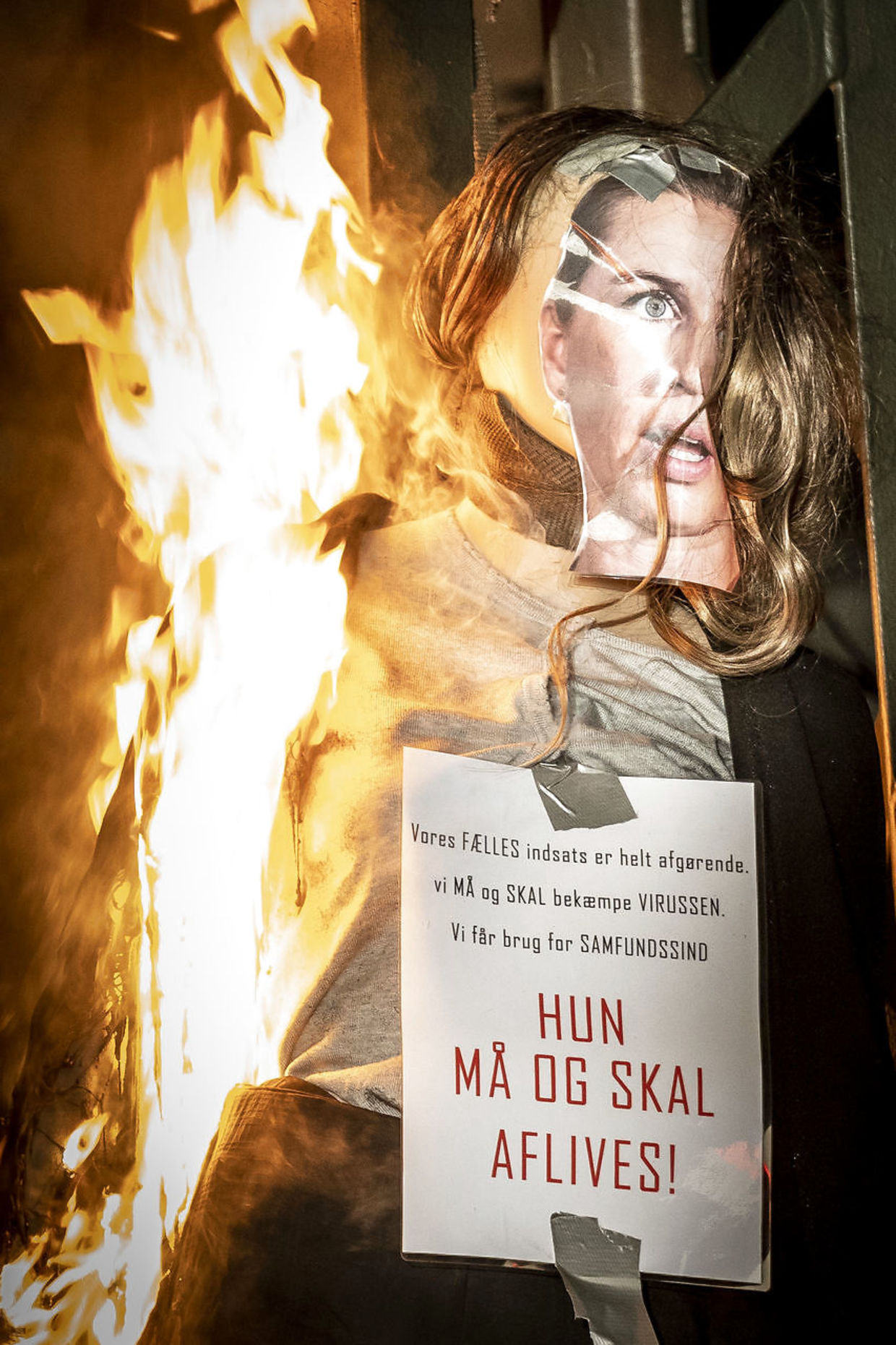
A few lockdown protestors from the Men in Black movement have been given extraordinarily long sentences (DK) on the basis of section 81d of the criminal code on “crimes related to the Covid-19 epidemic.” These include the woman who urged protestors to “smash the city in a non-violent way” before a riot that resulted in injuries to several police officers. Other protestors have been charged for actions during the demonstrations, including the man who burned a photo of Prime Minister Mette Frederiksen in effigy on a poster carrying the slogan “She must be and will be put down” (that is, euthanized, an allusion to the culling of large numbers of mink in Denmark last month). Some of the left-wing parties who voted for section 81d are now saying that the proposed sentences are unduly harsh.


22 February 2021

Coronavirus DK: Outbreak of B117 at schools

It’s a race between the slow-moving vaccines in the European Union bureaucracy and the opportunistic B117 mutation. 

Infections, hospitalizations, and deaths had been falling steadily for more than a month (DK) under the tight restrictions that are scheduled to run until February 28. The only easing since Christmas was opening schools up to the fourth grade. 

PM Mette Frederiksen burned in effigy at lockdown protest. Photo: Mads Claus Rasmussen.

Growing impatience with restrictions
As the situation improved, an increasing number of people have been agitating to allow stores, small businesses and schools to open up. Demonstrators from the Facebook group Men in Black have clashed with police and
burned Prime Minister Mette Frederiksen in effigy (DK) with the slogan “she must and shall be put down,” that is, euthanized. Another Facebook group planned a coordinated business opening in defiance of the rules.

There is a conspiracy theory element in the protests – people claiming that the pandemic is a hoax and a plot for pharma companies to profit and government to install permanent surveillance measures. But most lockdown skeptics seem to be motivated by economic hardship. Even rule-abiding retirees who don’t need get out and mix with people are getting restless. Last week the government announced that it would announce [sic] something about the restrictions this Wednesday, and many had anticipated further easing.

Now it's going after the children
Then two severe outbreaks occurred, one of them at a school in Kolding, Jutland (DK), where a case of the UK B117 mutation infected 67 people. Children had been thought to be largely resistant to the coronavirus, but it appears that the B117 mutation infects them more easily than the previous strains. Children do not usually become very sick, but they can become hidden superspreaders. 

The prevalence of the B117 mutation has been rising steadily and now accounts for more than 45% of cases. In the past two weeks, cases among young people under 20 were almost as high as for those 20-60. One-third of the 250 people infected in Kolding were under the age of 10. The municipality closed all the schools and day-care centers. It had wanted to test every resident age two and above in the coming week, but raised the threshold to 12.

Percentage of UK B117 coronavirus variant in Danish spot checks. 

Wildly optimistic vaccine prediction 
Meanwhile, the vaccine is still delayed. The government recently announced that it would be prepared to administer 400,000 vaccinations per day (DK). But at present only 10,000 people are being vaccinated per day, and the total vaccinated in two months is under 300,000. That is 5% of the population, which is still high by European standards. But the government apparently doesn’t buy the argument for First Doses First and has given second doses to 3%. People also ask why, in light of the delays in the EU plan, it hasn’t tried to buy the Russian vaccine directly.

The government had estimated that the entire population could get one dose by the end of May and a second by June 27. But if young people and children also need to be vaccinated, the process could go on through the summer. It also adds the standard warnings that after the vaccinations we will need to continue to take precautions, to see how long immunity from the vaccine lasts, and if an annual shot is needed, to see how the vaccine handles new mutations. There’s no return to normal on the calendar. 

29 January 2021

Coronavirus DK: Restrictions extended until March

In a press conference yesterday, Prime Minister Mette Frederiksen announced that Denmark will extend its tight pandemic restrictions (DK) an additional three weeks from February 7 to February 28. The main reason she gave was the B117 mutation: “We have seen how quickly the new mutation can bring things out of control. Therefore, we cannot ease the restrictions. Even though more people are being vaccinated, we must go forward carefully.” The measures include the closure of all restaurants, bars and retail businesses, except for supermarkets and pharmacies and a limit on gatherings to five persons. Frederiksen left open the possibility of allowing the youngest pupils, from kindergarten to fourth grade, to return to school before March.

PM Mette Frederiksen bringing bad news yet again. Photo: Liselotte Sabroe/Ritzau Scanpix.
.

The pandemic figures have been falling (DK) since the restrictions were put in place just before Christmas. Daily infections have dropped from around 3,000 to around 500; the percentage of positive tests from a peak of 4% to 0.6%; total hospitalizations from about 900 to 600; and the reproduction number from above 1.0 to 0.7. The percentage of infections deriving from the B117 mutation, however, has risen steadily to 13.%

Vaccine trouble
As in other European countries, the
delivery of vaccines has been delayed (DK). Denmark is part of the European Union deal on Pfizer and BioNTech vaccines. The State Serum Institute estimates that the vaccination of groups with lower priority will come around five weeks later than originally scheduled, in April and May. The agency still hopes that everyone will be vaccinated before the end of June. It is pursuing a policy of giving people the second dose of the vaccine three weeks after the first instead of the First Doses First approach taken by some countries in which the second dose is postponed for months in order to give more people the first dose sooner. Thus far, 3.15% of the population have received the first dose and 0.64% have received two doses.

An increasing number of business owners and others are disappointed and angered by the extension. Around 10% of businesses are reported to have serious liquidity problems and are at risk of going bankrupt. In response, the government today announced a new aid package (DK) of loans and other measures worth DKK 170 billion (USD 27 billion). 

Travel scandals
Others are also becoming impatient with the restrictions. There have been a couple of minor scandals recently concerning violations of travel restrictions. Some people have
taken to ski resorts in Austria (DK), one of the main hotspots one year ago, under the guise of pursing job opportunities. Last week, it was reported that 50 infected persons had entered Denmark from Dubai (DK) in January. Some 33 of them arrived after the January 9 requirement that passengers coming to Denmark be tested. They had all received negative test results in Dubai before boarding the flight, and there is suspicion of “irregularities” in the testing in Dubai. Some of the travelers were professional athletes and influencers who shared their trip on social media despite the restrictions on travel abroad. After this discovery, the Danish authorities suspended flights from Dubai to Denmark for five days.

After double overtime
But all isn’t doom and gloom. On Wednesday, at the World Handball Championships, the Danish men’s team beat host team Egypt by a score of 39-38 on the final penalty shot in “the most insane handball game in the history of the world,” according to the commentator Henrik Liniger. The team qualified for the semifinal against Spain, which you can watch this evening at 8:30 pm CET (2:30 pm EST) on dr.dk.

21 January 2021

Danish reactions to Biden’s inauguration

 Today we take a break from disease and see what Danish politicians have to say about the changing of the guard in the White House. It might not be very surprising, but let’s indulge in a little celebration and relief. It’s been a long four years for Western Europe to watch its greatest ally go rogue and then descend into antidemocratic chaos. Here are the party leaders:

Prime Minister Mette Frederiksen (DK) of the Social Democratic party:

“I hope that President Biden will be a unifying force after the unrest and division that we have unfortunately seen grow in the United States.”

Jakob Ellemann-Jensen (DK) of the Liberal Party:

“Now the world will be a more decent place … I look forward to being able to recognize an America that takes global leadership and is engaged in its surroundings.”

Pia Olsen Dyhr (DK) of the Socialist People’s Party: 

“Such a festive day. It’s hard not to be enthusiastic.”

Sofie Carsten Nielsen (DK) of the Social Liberal party:

“American democracy is being challenged, and it will be a gigantic task to gather people together. But today I will allow myself to hope … We must speak out against populism - but not turn our backs on the people who pursue populism. For we must speak together and solve the problems that nurture discouragement and the experience of loss of control and distrust of the establishment.”

Pernille Skipper (DK) of the Red-Green Party, retweeting a thread with photos of “some of the weirdest & dumbest sh*t our failed dictator did…”:

“Now I dare again to make fun of him … Priceless”:

Former leader of the free world staring into the sun during a solar eclipse


On the significance for the world 
In an interview on Danish television (DK), Anders Fogh Rasmussen, former Danish prime minister (from the right-wing Liberal Party) and NATO general secretary, was asked, “Is there anything about Trump’s tenure you will miss?”

“No, not a single thing. He will certainly go down in history as the worst president the United States has ever had. He created division in the US, and he weakened the free world outside of the country. . . . He leaves a more insecure world than the one he took over. So it is a great relief for us all that he is gone, and I look forward very much to Biden as president.”

Foreign Minister Jeppe Kofod added:

“[Trump] dragged the United States out of the world at a time when it had the greatest need for American leadership … The United States has the best in the world and the worst in the world gathered together in one place. . . . And what we saw on January 6, that was one of the worst things in the world.”

10 January 2021

Coronavirus DK: Riots, Danish style

Perhaps inspired by the MAGA mob that stormed the US Capitol building, a Danish group calling itself “Men in Black” held protest demonstrations in Copenhagen (DK) and Aalborg yesterday evening. The demonstrations had been announced in advance and were therefore legal. Demonstrations are the only exception to the limit on public gatherings. Several hundred people - indeed mostly attired in black, both guys and gals - met up at the Copenhagen City Hall Plaza around 7 p.m. to listen to speakers who led them in chants: “Freedom for Denmark! We have had enough!” 

The purpose of event was apparently to complain about lockdown restrictions, which have recently been tightened in Denmark, as they have nearly everywhere else. I say “apparently” because that was how it was described by more than one journalist on the scene. The police also reported that they recognized some figures from the “hooligan scene,” that is, soccer fans who fight with supporters of rival teams. 

Demonstrators at CPH City Hall Plaza. Photo: Jonas Moestrup / TV 2

At various times, the speakers expressed objections to the mask requirement and other restrictions, warned that the vaccine is dangerous, and asserted that the coronavirus crisis was a hoax (DK): “We are mad, we are tired, and we are about to go crazy. Where is that virus?” Individual protestors interviewed advocated the theory of a worldwide conspiracy led by Bill Gates and the pharma industry, claiming also that the Danish state had engineered the bankruptcy of small shops so that it could take them over for financial gain. In recent months there have been a few other demonstrations against restrictions, which have all been peaceful. 

“Smash the city in a non-violent way”
In the beginning, the crowd was content to light torches and listen to its leaders, who urged them on with a distinctly Danish moderation: “Are you ready to smash the city in a non-violent way?” The crowd might have had trouble interpreting that exhortation, perhaps unique in the history of insurrectionary war cries
. They began shooting fireworks (which are legal only around New Year’s Eve), throwing beer bottles, and then marching down Strøget, the main pedestrian street in the commercial district. 

The police were well prepared for them, however. Vans full of them were waiting on Strøget with their batons drawn, and they drove the crowd back to City Hall Plaza. They announced over loudspeakers that the demonstration was over and people should disperse, “in the name of the Queen and the Law.” The crowd broke up into smaller groups and headed down side streets, with much confusion, taunting, and yelling. There seemed to be little direct fighting between the factions, although the demonstrators shot fireworks at police vans. 

Quick and painless
The demonstrators continued into the Nørrebro district, with the police following close after. The police arrested several people for fireworks violations, resisting arrest, and attacking officers. Smaller groups of up to one hundred coalesced at a few locations, and there were low-key confrontations. But by around 9:30 p.m., activity had quieted down and the police announced that it was “slowly putting the city to bed.”

The demonstrations in Aalborg were smaller and were dispersed even more quickly. A total of 23 people were arrested. No one was reported injured in either city. You can see several brief video clips at the links.

30 December 2020

Restrictions extended / Get MEET THE DANES for free

Special limited-time offer
On the Kindle edition of Meet the Danes on the first weekend of what should be a better year (Jan. 2-3): The price is reduced to $0.00, which converts to DKK 0,00.

Stay hunkered down
At a press conference yesterday, December 29, Prime Minister Mette Frederiksen, who may have aged five years in 2020, announced that the restrictions imposed last week would be extended an additional two weeks (DK) from January 3 to January 17. “The situation regarding infection figures, hospitalizations and deaths is now more serious than it was in the spring,” she said. Small businesses, retail outlets except for supermarkets and pharmacies, bars, and restaurants except for takeout must remain closed.


Healthcare staff conducting Covid-19 test. Photo: Niels Christian Vilmann © Scanpix.

The number of daily infections has fallen from the peak of 4,000 a week ago, but several nursing homes have seen serious outbreaks. With 900 admissions, hospitals are under pressure (DK) to find vacant beds and are postponing all non-urgent operations. 

Netflix and chill NYE
Ministers and health officials warn people to skip New Year’s Eve parties (DK) this year: Cancel plans to see people that you don’t normally see; limit gatherings to your household and perhaps a few familiar persons, no more than ten; avoid popular outdoor sites. The police will close the City Hall Plaza, which traditionally attracts the largest crowds.

17 December 2020

Coronavirus DK: Lockdown redux

Like most other Western European countries, Denmark is going back into total lockdown. On Wednesday, Prime Minister Mette Frederiksen and the pandemic task force held another press conference (DK) to announce further restrictions beyond the ones implemented last week. “We are doing it,” said Frederiksen, “because an epidemic that runs out of control will have serious consequences and more serious consequences than closing down now will have.”

Mette Frederiksen and Magnus Heunicke at press conference. Photo: Mads Claus Rasmussen © Scanpix.

Record-high infections

The risk rating for the entire country was raised to 4, the second-highest level. On the same day as the press conference, the State Serum Institute reported the highest number of infections ever, 3,692. More than 22,000 cases were registered in the past week, and hospitalizations rose by 54 to 493. 

The following additional organizations and activities were ordered to close (DK) during the coming week:

  • Beginning today, Thursday, the 17th, shopping centers and department stores.
  • Beginning on Monday, the 21st, boarding schools; and small businesses; and the remaining elementary school pupils, from kindergarten to the fourth grade. Other students had already been attending classes online.
  • From December 25 to January 3, all retails shops except supermarkets and pharmacies.

Christmas not canceled

The limit on gatherings is unchanged at ten, but Frederiksen urged people to limit Christmas festivities as much as possible. Earlier, the State Serum Institute estimated that the Christmas holidays would cause the number of infections to double. Certain researchers have recommended closing the Great Belt Bridge, which connects Zealand to Funen and Jutland, in order to prevent the virus from spreading from the hotspot of Greater Copenhagen. The government has decided against it, however, because Christmas is a “special holiday,” said Søren Bostrøm, head of the Healthcare Authority. The police noted their concerns about New Year’s Eve, warning people not to gather at the traditional locations such as Copenhagen City Hall Plaza.

Exception for daycare centers

The only major institutions that aren’t closing are daycare centers, and the leaders and staff are complaining (DK) about it. Children do not often get sick, but they infect their parents, they note. Many staff members are sick or quarantined, putting more pressure on those who remain. The government’s rationale, according to Magnus Heunicke, Minister of Health, is that someone has to take care of the children of essential workers, such as healthcare staff and the police, and the Health Authority does not consider the risks at daycare centers to be high. “The healthcare system is under pressure,” said Bostrøm, “and we need to prioritize so that the staff can take care of the sickest patients.” That means, among other things, that elective surgery may be postponed until January.

Frederiksen doubts that these latest measures will have a significant effect on the Danish economy, which has performed better in 2020 than had been expected during the lockdown in the spring. The government is already at work on a new relief package for businesses and employees who are affected by the lockdown. 


15 December 2020

New release: Meet the Danes: a novel

Here's my excuse for slacking off on Coronravirus DK earlier this year, when things were going much better in Denmark. I have spent my lockdown time dusting off an old manuscript from the vault and shining it up.

Now I'm publishing my first novel:


Meet the Danes: a novel

 From the back cover:

Meet the Danes is a rollicking satire of 1980s American pop culture disastrously transplanted into the unsuspecting nation of Denmark … and Hans Christian Andersen’s fairy-tale land will never be the same.

When newlywed but jobless academic Norman McKay follows his wife, Kirsten, back to her homeland, he struggles to fit in—until by chance he gets recruited to help launch Denmark’s first commercial television network, DK2. With programming fueled by Norman’s twisted take on American viewing habits, DK2 sparks a culture war that quickly spirals out of control, sowing confusion, political controversy, violent resistance, and murder. Norman’s increasingly desperate attempts to salvage DK2 and prove his goodwill only end up sabotaging his marriage, incurring a centerfold’s wrath, and provoking U.S. military aggression against its puny NATO ally.

Can Norman pull the plug before it’s too late? Television overtakes reality and reality imitates television as the world’s oldest kingdom careens into surrealistic turmoil.


Readers of the blog will find the tone of the book rather different, but I hope you will enjoy it. Please share this announcement with anyone you think might be interested.

Paperback and Kindle editions are available on the Amazon sites—in the US, the UK, and Germany—and the paperback will soon be available on other online bookstores. 


08 December 2020

Coronavirus DK: Second wave takes its toll on social activity

Yesterday, Monday, December 7, the Danish government announced a new set of restrictions for the capital region and the two other largest cities. It was the day that the restrictions announced last week took effect and also the first day with more than 2,000 new infections. The State Serum Institute had presented a projection (DK) showing that, if nothing were done, the healthcare system could come under pressure before Christmas, with more than 4,000 daily infections and 500 hospitalizations. Increasing the tracing activity wouldn’t be sufficient to stop the spread from accelerating. The situation could be worse than in the spring, the report said, since there could be a shortage of healthcare staff because of a greater emphasis on quarantining people who are exposed to the virus. 

Back to takeout for urban eateries. Photo: Oscar Scott Carl © Scanpix.

These are the latest measures (DK), which apply from Wednesday, December 9, to January 3:

  • Thirty-eight municipalities, with a total of 2.8 million residents – almost half the country – will be partially locked down.
  • Restaurants and bars may not serve guests; they can offer takeout.
  • Theaters, concert halls, museums, libraries and other public buildings are closed.
  • Schools and universities from the fifth grade upwards must operate online; daycare centers will stay open.
  • Civil servants are to work at home as much as possible.
  • Indoor sports and other recreational activities are closed; professional sports events can continue, with a limit of 500 spectators.
  • People in the affected municipalities should comply with these restrictions generally and not travel to other regions in order to participate in the banned activities.
  • Families should limit Christmas gatherings to ten people.

The usual debate
Two virologists who have often been consulted about the pandemic disagree about the decision (DK). Søren Riis Paludan from Aarhus University thinks that the government should have waited to implement the restrictions until December 20, when the country normally closes down partially for the holidays, because of the high costs for education and the economy. 

On the other hand, Allan Randrup Thomsen of the University of Copenhagen says the new restrictions should have been included in the policies announced last week. He believes that recent half-measures such as closing bars and restaurants at 10 p.m. have not worked because people simply adjust their behavior, by going out earlier, for example. The researchers do agree, however, that Christmas traditions pose an increased threat of infection and that the course of the pandemic depends on people taking responsibility themselves for minimizing the dangers. 

Good news for country inns
Economists are sounding the alarm (DK) that, because of the new measures, business activity will get off to a slow start in 2021, when it was supposed to recover. Jeppe Juul Borre from Arbejdernes Landsbank notes that 60 percent of the country’s hospitality industry, which has already been the hardest hit by the pandemic, lies in the affected municipalities. He has reduced his GDP estimate for this year and warns that unemployment could rebound after falling over the summer.

There will always be arguments on both sides. Some political parties are criticizing the government (DK) for waiting too long to act, and some restaurants outside the cities are reporting a surge in reservations (DK) from people in the lockdown areas.

02 December 2020

Coronavirus DK: Making Christmas safe for grandparents

Yesterday the Danish government held a press conference to announce new restrictions (DK) because of the persistently high level of infections in the Greater Copenhagen region. The pandemic is not accelerating significantly, and the hospitals are not filling. But in past the month infections have remained much higher than in the spring, and they hit a record number yesterday (DK), at 1,468.

Minister of Health Magnus Heunicke, along with several other officials, presented the new measures, which take effect on December 7. The restrictions apply to 17 municipalities, which on average have a higher incidence of infection and higher positive test rate than the rest of the country. Heunicke explained that the restrictions are necessary because the pandemic is expected to spread more easily during the winter months and people are also more likely to gather during the holidays. He acknowledged that people are tired of pandemic and the restrictions but urged everyone to comply during the coming month because of the prospect of vaccine becoming available early in next year.

Invitation to all-inclusive staycation © Grafik: Mads Peter Ogstrup Nielsen

Talking about you, young people
Heunicke focused on measures to contain the spread of the virus among students and young adults. The most striking trend in infection statistics in the past few weeks has been a disproportionate number of cases in the 10-19 and 20-29 age groups. This reflects the facts that young people circulate more widely and may be less concerned about the virus than older people because they experience milder symptoms and recover more easily. But Heunicke cautioned that even if they are not threatened as seriously, they still pose a risk to others, particularly during the holidays when families gather across generations. He issued what amounted to a plea to this group to moderate their behavior until the vaccine can be dispensed.

The main initiative in the new measures is therefore a campaign, beginning today, to test everyone from 15 to 25 in the metropolitan region before Christmas. That is around 200,000 young people. There will be mobile units visiting schools and universities as well as additional testing capacity at existing test centers. The tracing staff will be increased, and there will be better conditions at isolation facilities, including meals free of charge. Other measures include limitations on contact for schoolchildren in classrooms and a maximum of 10 in sports and other after-school activities.

Work at home, shop alone, party next year
Workplaces and higher educational institutions are urged to conduct activities online. Large retail outlets and shopping centers are to monitor customer traffic and allow more space per customer, and people are urged to do their Christmas shopping alone. There are selective restrictions and bans on visiting nursing homes that have seen outbreaks. People are urged generally to see as few others as possible, with a maximum of 10 at both private and public gatherings. 

Heunicke and the other officials noted that the situation in Denmark is not as dire and the new measures are not as strict as in several other European countries, but the country has recently had to deal with outbreaks at mink farms and in the western suburbs and it must remain vigilant. The main purpose of effort is to avert a surge of infections that could take place after people travel and gather for holiday shopping and gatherings.