Nav Menu (Do Not Edit Here!)

Home     About     Contact
Showing posts with label lockdown. Show all posts

22 February 2021

Coronavirus DK: Outbreak of B117 at schools

It’s a race between the slow-moving vaccines in the European Union bureaucracy and the opportunistic B117 mutation. 

Infections, hospitalizations, and deaths had been falling steadily for more than a month (DK) under the tight restrictions that are scheduled to run until February 28. The only easing since Christmas was opening schools up to the fourth grade. 
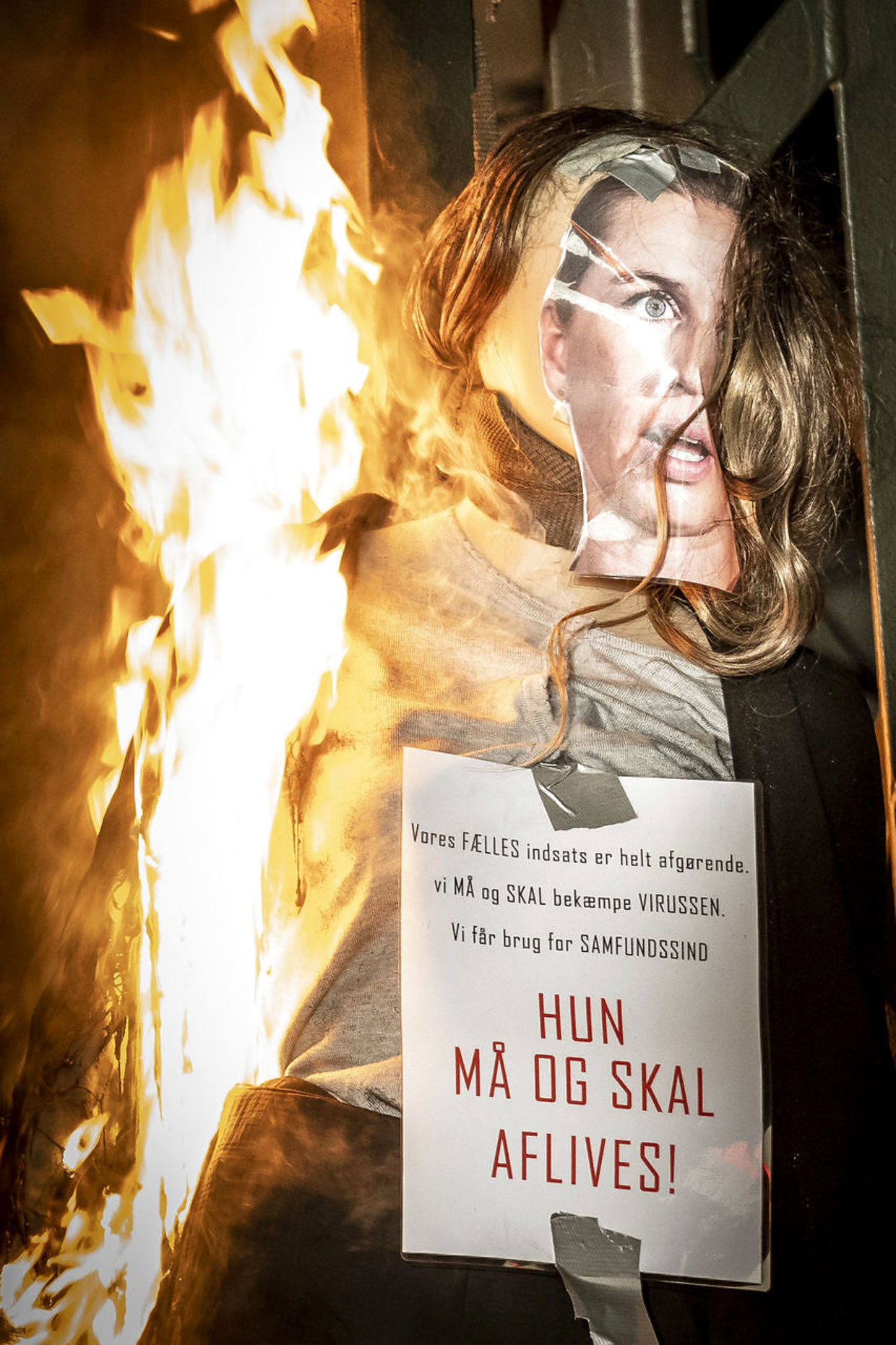
PM Mette Frederiksen burned in effigy at lockdown protest. Photo: Mads Claus Rasmussen.

Growing impatience with restrictions
As the situation improved, an increasing number of people have been agitating to allow stores, small businesses and schools to open up. Demonstrators from the Facebook group Men in Black have clashed with police and
burned Prime Minister Mette Frederiksen in effigy (DK) with the slogan “she must and shall be put down,” that is, euthanized. Another Facebook group planned a coordinated business opening in defiance of the rules.

There is a conspiracy theory element in the protests – people claiming that the pandemic is a hoax and a plot for pharma companies to profit and government to install permanent surveillance measures. But most lockdown skeptics seem to be motivated by economic hardship. Even rule-abiding retirees who don’t need get out and mix with people are getting restless. Last week the government announced that it would announce [sic] something about the restrictions this Wednesday, and many had anticipated further easing.

Now it's going after the children
Then two severe outbreaks occurred, one of them at a school in Kolding, Jutland (DK), where a case of the UK B117 mutation infected 67 people. Children had been thought to be largely resistant to the coronavirus, but it appears that the B117 mutation infects them more easily than the previous strains. Children do not usually become very sick, but they can become hidden superspreaders. 

The prevalence of the B117 mutation has been rising steadily and now accounts for more than 45% of cases. In the past two weeks, cases among young people under 20 were almost as high as for those 20-60. One-third of the 250 people infected in Kolding were under the age of 10. The municipality closed all the schools and day-care centers. It had wanted to test every resident age two and above in the coming week, but raised the threshold to 12.

Percentage of UK B117 coronavirus variant in Danish spot checks. 

Wildly optimistic vaccine prediction 
Meanwhile, the vaccine is still delayed. The government recently announced that it would be prepared to administer 400,000 vaccinations per day (DK). But at present only 10,000 people are being vaccinated per day, and the total vaccinated in two months is under 300,000. That is 5% of the population, which is still high by European standards. But the government apparently doesn’t buy the argument for First Doses First and has given second doses to 3%. People also ask why, in light of the delays in the EU plan, it hasn’t tried to buy the Russian vaccine directly.

The government had estimated that the entire population could get one dose by the end of May and a second by June 27. But if young people and children also need to be vaccinated, the process could go on through the summer. It also adds the standard warnings that after the vaccinations we will need to continue to take precautions, to see how long immunity from the vaccine lasts, and if an annual shot is needed, to see how the vaccine handles new mutations. There’s no return to normal on the calendar. 

29 January 2021

Coronavirus DK: Restrictions extended until March

In a press conference yesterday, Prime Minister Mette Frederiksen announced that Denmark will extend its tight pandemic restrictions (DK) an additional three weeks from February 7 to February 28. The main reason she gave was the B117 mutation: “We have seen how quickly the new mutation can bring things out of control. Therefore, we cannot ease the restrictions. Even though more people are being vaccinated, we must go forward carefully.” The measures include the closure of all restaurants, bars and retail businesses, except for supermarkets and pharmacies and a limit on gatherings to five persons. Frederiksen left open the possibility of allowing the youngest pupils, from kindergarten to fourth grade, to return to school before March.

PM Mette Frederiksen bringing bad news yet again. Photo: Liselotte Sabroe/Ritzau Scanpix.
.

The pandemic figures have been falling (DK) since the restrictions were put in place just before Christmas. Daily infections have dropped from around 3,000 to around 500; the percentage of positive tests from a peak of 4% to 0.6%; total hospitalizations from about 900 to 600; and the reproduction number from above 1.0 to 0.7. The percentage of infections deriving from the B117 mutation, however, has risen steadily to 13.%

Vaccine trouble
As in other European countries, the
delivery of vaccines has been delayed (DK). Denmark is part of the European Union deal on Pfizer and BioNTech vaccines. The State Serum Institute estimates that the vaccination of groups with lower priority will come around five weeks later than originally scheduled, in April and May. The agency still hopes that everyone will be vaccinated before the end of June. It is pursuing a policy of giving people the second dose of the vaccine three weeks after the first instead of the First Doses First approach taken by some countries in which the second dose is postponed for months in order to give more people the first dose sooner. Thus far, 3.15% of the population have received the first dose and 0.64% have received two doses.

An increasing number of business owners and others are disappointed and angered by the extension. Around 10% of businesses are reported to have serious liquidity problems and are at risk of going bankrupt. In response, the government today announced a new aid package (DK) of loans and other measures worth DKK 170 billion (USD 27 billion). 

Travel scandals
Others are also becoming impatient with the restrictions. There have been a couple of minor scandals recently concerning violations of travel restrictions. Some people have
taken to ski resorts in Austria (DK), one of the main hotspots one year ago, under the guise of pursing job opportunities. Last week, it was reported that 50 infected persons had entered Denmark from Dubai (DK) in January. Some 33 of them arrived after the January 9 requirement that passengers coming to Denmark be tested. They had all received negative test results in Dubai before boarding the flight, and there is suspicion of “irregularities” in the testing in Dubai. Some of the travelers were professional athletes and influencers who shared their trip on social media despite the restrictions on travel abroad. After this discovery, the Danish authorities suspended flights from Dubai to Denmark for five days.

After double overtime
But all isn’t doom and gloom. On Wednesday, at the World Handball Championships, the Danish men’s team beat host team Egypt by a score of 39-38 on the final penalty shot in “the most insane handball game in the history of the world,” according to the commentator Henrik Liniger. The team qualified for the semifinal against Spain, which you can watch this evening at 8:30 pm CET (2:30 pm EST) on dr.dk.

10 January 2021

Coronavirus DK: Riots, Danish style

Perhaps inspired by the MAGA mob that stormed the US Capitol building, a Danish group calling itself “Men in Black” held protest demonstrations in Copenhagen (DK) and Aalborg yesterday evening. The demonstrations had been announced in advance and were therefore legal. Demonstrations are the only exception to the limit on public gatherings. Several hundred people - indeed mostly attired in black, both guys and gals - met up at the Copenhagen City Hall Plaza around 7 p.m. to listen to speakers who led them in chants: “Freedom for Denmark! We have had enough!” 

The purpose of event was apparently to complain about lockdown restrictions, which have recently been tightened in Denmark, as they have nearly everywhere else. I say “apparently” because that was how it was described by more than one journalist on the scene. The police also reported that they recognized some figures from the “hooligan scene,” that is, soccer fans who fight with supporters of rival teams. 

Demonstrators at CPH City Hall Plaza. Photo: Jonas Moestrup / TV 2

At various times, the speakers expressed objections to the mask requirement and other restrictions, warned that the vaccine is dangerous, and asserted that the coronavirus crisis was a hoax (DK): “We are mad, we are tired, and we are about to go crazy. Where is that virus?” Individual protestors interviewed advocated the theory of a worldwide conspiracy led by Bill Gates and the pharma industry, claiming also that the Danish state had engineered the bankruptcy of small shops so that it could take them over for financial gain. In recent months there have been a few other demonstrations against restrictions, which have all been peaceful. 

“Smash the city in a non-violent way”
In the beginning, the crowd was content to light torches and listen to its leaders, who urged them on with a distinctly Danish moderation: “Are you ready to smash the city in a non-violent way?” The crowd might have had trouble interpreting that exhortation, perhaps unique in the history of insurrectionary war cries
. They began shooting fireworks (which are legal only around New Year’s Eve), throwing beer bottles, and then marching down Strøget, the main pedestrian street in the commercial district. 

The police were well prepared for them, however. Vans full of them were waiting on Strøget with their batons drawn, and they drove the crowd back to City Hall Plaza. They announced over loudspeakers that the demonstration was over and people should disperse, “in the name of the Queen and the Law.” The crowd broke up into smaller groups and headed down side streets, with much confusion, taunting, and yelling. There seemed to be little direct fighting between the factions, although the demonstrators shot fireworks at police vans. 

Quick and painless
The demonstrators continued into the Nørrebro district, with the police following close after. The police arrested several people for fireworks violations, resisting arrest, and attacking officers. Smaller groups of up to one hundred coalesced at a few locations, and there were low-key confrontations. But by around 9:30 p.m., activity had quieted down and the police announced that it was “slowly putting the city to bed.”

The demonstrations in Aalborg were smaller and were dispersed even more quickly. A total of 23 people were arrested. No one was reported injured in either city. You can see several brief video clips at the links.

30 December 2020

Restrictions extended / Get MEET THE DANES for free

Special limited-time offer
On the Kindle edition of Meet the Danes on the first weekend of what should be a better year (Jan. 2-3): The price is reduced to $0.00, which converts to DKK 0,00.

Stay hunkered down
At a press conference yesterday, December 29, Prime Minister Mette Frederiksen, who may have aged five years in 2020, announced that the restrictions imposed last week would be extended an additional two weeks (DK) from January 3 to January 17. “The situation regarding infection figures, hospitalizations and deaths is now more serious than it was in the spring,” she said. Small businesses, retail outlets except for supermarkets and pharmacies, bars, and restaurants except for takeout must remain closed.


Healthcare staff conducting Covid-19 test. Photo: Niels Christian Vilmann © Scanpix.

The number of daily infections has fallen from the peak of 4,000 a week ago, but several nursing homes have seen serious outbreaks. With 900 admissions, hospitals are under pressure (DK) to find vacant beds and are postponing all non-urgent operations. 

Netflix and chill NYE
Ministers and health officials warn people to skip New Year’s Eve parties (DK) this year: Cancel plans to see people that you don’t normally see; limit gatherings to your household and perhaps a few familiar persons, no more than ten; avoid popular outdoor sites. The police will close the City Hall Plaza, which traditionally attracts the largest crowds.

17 December 2020

Coronavirus DK: Lockdown redux

Like most other Western European countries, Denmark is going back into total lockdown. On Wednesday, Prime Minister Mette Frederiksen and the pandemic task force held another press conference (DK) to announce further restrictions beyond the ones implemented last week. “We are doing it,” said Frederiksen, “because an epidemic that runs out of control will have serious consequences and more serious consequences than closing down now will have.”

Mette Frederiksen and Magnus Heunicke at press conference. Photo: Mads Claus Rasmussen © Scanpix.

Record-high infections

The risk rating for the entire country was raised to 4, the second-highest level. On the same day as the press conference, the State Serum Institute reported the highest number of infections ever, 3,692. More than 22,000 cases were registered in the past week, and hospitalizations rose by 54 to 493. 

The following additional organizations and activities were ordered to close (DK) during the coming week:

  • Beginning today, Thursday, the 17th, shopping centers and department stores.
  • Beginning on Monday, the 21st, boarding schools; and small businesses; and the remaining elementary school pupils, from kindergarten to the fourth grade. Other students had already been attending classes online.
  • From December 25 to January 3, all retails shops except supermarkets and pharmacies.

Christmas not canceled

The limit on gatherings is unchanged at ten, but Frederiksen urged people to limit Christmas festivities as much as possible. Earlier, the State Serum Institute estimated that the Christmas holidays would cause the number of infections to double. Certain researchers have recommended closing the Great Belt Bridge, which connects Zealand to Funen and Jutland, in order to prevent the virus from spreading from the hotspot of Greater Copenhagen. The government has decided against it, however, because Christmas is a “special holiday,” said Søren Bostrøm, head of the Healthcare Authority. The police noted their concerns about New Year’s Eve, warning people not to gather at the traditional locations such as Copenhagen City Hall Plaza.

Exception for daycare centers

The only major institutions that aren’t closing are daycare centers, and the leaders and staff are complaining (DK) about it. Children do not often get sick, but they infect their parents, they note. Many staff members are sick or quarantined, putting more pressure on those who remain. The government’s rationale, according to Magnus Heunicke, Minister of Health, is that someone has to take care of the children of essential workers, such as healthcare staff and the police, and the Health Authority does not consider the risks at daycare centers to be high. “The healthcare system is under pressure,” said Bostrøm, “and we need to prioritize so that the staff can take care of the sickest patients.” That means, among other things, that elective surgery may be postponed until January.

Frederiksen doubts that these latest measures will have a significant effect on the Danish economy, which has performed better in 2020 than had been expected during the lockdown in the spring. The government is already at work on a new relief package for businesses and employees who are affected by the lockdown. 


08 December 2020

Coronavirus DK: Second wave takes its toll on social activity

Yesterday, Monday, December 7, the Danish government announced a new set of restrictions for the capital region and the two other largest cities. It was the day that the restrictions announced last week took effect and also the first day with more than 2,000 new infections. The State Serum Institute had presented a projection (DK) showing that, if nothing were done, the healthcare system could come under pressure before Christmas, with more than 4,000 daily infections and 500 hospitalizations. Increasing the tracing activity wouldn’t be sufficient to stop the spread from accelerating. The situation could be worse than in the spring, the report said, since there could be a shortage of healthcare staff because of a greater emphasis on quarantining people who are exposed to the virus. 

Back to takeout for urban eateries. Photo: Oscar Scott Carl © Scanpix.

These are the latest measures (DK), which apply from Wednesday, December 9, to January 3:

  • Thirty-eight municipalities, with a total of 2.8 million residents – almost half the country – will be partially locked down.
  • Restaurants and bars may not serve guests; they can offer takeout.
  • Theaters, concert halls, museums, libraries and other public buildings are closed.
  • Schools and universities from the fifth grade upwards must operate online; daycare centers will stay open.
  • Civil servants are to work at home as much as possible.
  • Indoor sports and other recreational activities are closed; professional sports events can continue, with a limit of 500 spectators.
  • People in the affected municipalities should comply with these restrictions generally and not travel to other regions in order to participate in the banned activities.
  • Families should limit Christmas gatherings to ten people.

The usual debate
Two virologists who have often been consulted about the pandemic disagree about the decision (DK). Søren Riis Paludan from Aarhus University thinks that the government should have waited to implement the restrictions until December 20, when the country normally closes down partially for the holidays, because of the high costs for education and the economy. 

On the other hand, Allan Randrup Thomsen of the University of Copenhagen says the new restrictions should have been included in the policies announced last week. He believes that recent half-measures such as closing bars and restaurants at 10 p.m. have not worked because people simply adjust their behavior, by going out earlier, for example. The researchers do agree, however, that Christmas traditions pose an increased threat of infection and that the course of the pandemic depends on people taking responsibility themselves for minimizing the dangers. 

Good news for country inns
Economists are sounding the alarm (DK) that, because of the new measures, business activity will get off to a slow start in 2021, when it was supposed to recover. Jeppe Juul Borre from Arbejdernes Landsbank notes that 60 percent of the country’s hospitality industry, which has already been the hardest hit by the pandemic, lies in the affected municipalities. He has reduced his GDP estimate for this year and warns that unemployment could rebound after falling over the summer.

There will always be arguments on both sides. Some political parties are criticizing the government (DK) for waiting too long to act, and some restaurants outside the cities are reporting a surge in reservations (DK) from people in the lockdown areas.

02 December 2020

Coronavirus DK: Making Christmas safe for grandparents

Yesterday the Danish government held a press conference to announce new restrictions (DK) because of the persistently high level of infections in the Greater Copenhagen region. The pandemic is not accelerating significantly, and the hospitals are not filling. But in past the month infections have remained much higher than in the spring, and they hit a record number yesterday (DK), at 1,468.

Minister of Health Magnus Heunicke, along with several other officials, presented the new measures, which take effect on December 7. The restrictions apply to 17 municipalities, which on average have a higher incidence of infection and higher positive test rate than the rest of the country. Heunicke explained that the restrictions are necessary because the pandemic is expected to spread more easily during the winter months and people are also more likely to gather during the holidays. He acknowledged that people are tired of pandemic and the restrictions but urged everyone to comply during the coming month because of the prospect of vaccine becoming available early in next year.

Invitation to all-inclusive staycation © Grafik: Mads Peter Ogstrup Nielsen

Talking about you, young people
Heunicke focused on measures to contain the spread of the virus among students and young adults. The most striking trend in infection statistics in the past few weeks has been a disproportionate number of cases in the 10-19 and 20-29 age groups. This reflects the facts that young people circulate more widely and may be less concerned about the virus than older people because they experience milder symptoms and recover more easily. But Heunicke cautioned that even if they are not threatened as seriously, they still pose a risk to others, particularly during the holidays when families gather across generations. He issued what amounted to a plea to this group to moderate their behavior until the vaccine can be dispensed.

The main initiative in the new measures is therefore a campaign, beginning today, to test everyone from 15 to 25 in the metropolitan region before Christmas. That is around 200,000 young people. There will be mobile units visiting schools and universities as well as additional testing capacity at existing test centers. The tracing staff will be increased, and there will be better conditions at isolation facilities, including meals free of charge. Other measures include limitations on contact for schoolchildren in classrooms and a maximum of 10 in sports and other after-school activities.

Work at home, shop alone, party next year
Workplaces and higher educational institutions are urged to conduct activities online. Large retail outlets and shopping centers are to monitor customer traffic and allow more space per customer, and people are urged to do their Christmas shopping alone. There are selective restrictions and bans on visiting nursing homes that have seen outbreaks. People are urged generally to see as few others as possible, with a maximum of 10 at both private and public gatherings. 

Heunicke and the other officials noted that the situation in Denmark is not as dire and the new measures are not as strict as in several other European countries, but the country has recently had to deal with outbreaks at mink farms and in the western suburbs and it must remain vigilant. The main purpose of effort is to avert a surge of infections that could take place after people travel and gather for holiday shopping and gatherings.

07 October 2020

Coronavirus DK: Second wave may be losing steam

 According to tradition, Parliament opens its annual session on the first Tuesday in October, and the prime minister gives a speech on the state of the nation (DK). PM Mette Frederiksen used the occasion to emphasize that, although the country has undergone a resurgence of coronavirus infections, the epidemic is under control: “We have proved that we can both protect individual lives and at the same time be one of the economies that emerges the strongest from the pandemic.” She announced that the government has established a new warning system that will allow the authorities to adjust restrictions more easily. 

This is the status: On Tuesday, October 7, there were 322 new cases of infection (DK), the lowest level since September 11, down from the peak of 652 on September 23. The number hospitalized has been rising slowly but steadily to 124, and the number of death now totals 633. The reproduction number has fallen below 1.0 for the first time since August. Testing has increased recently to about 50,000 per day. More than 23,000 are reported to have recovered from the infection.+

Even though the trend in infections is falling, a large majority of municipalities, 80 out of 98, still have an infection rate above 20 per 10,000 during the past week, the threshold for restricting travel to foreign countries. In the past week, the rate fell in 60 municipalities and rose in 30. 


PM Mette Frederiksen at the opening of Parliament. Photo: Mads Claus Rasmussen / Scanpix.


First MP infected

One person who missed the opening speech was Bjørn Brandenborg, the first member of Parliament to become infected (DK). Brandenborg is a Social Democrat and chair of the Tax Committee who was elected to Parliament in 2019. He took part in a committee meeting last Tuesday at which all participants observed social distancing and hand hygiene. He noticed symptoms the next morning, was tested immediately, and notified his contacts. There have been no reports of other MPs catching the infection since then.

The Minister of Justice has proposed increasing the fine for taking part in gatherings of more than 50 people in order to stop the so-called “pirate parties” (DK) that young people have been caught holding on weekends. The fine is currently DKK 2,500 (USD 400). It will be raised to DKK 4,000 (USD 630) for participants and DKK 10,000 (USD 1,600) for arrangers. The police have extended the closure of two areas in Copenhagen (DK) where young people have held parties and will continue monitoring several other popular hangouts. 

No trick or treat this year
The Health Authority has put a damper on Halloween (DK). It recommends that children not go door to door and avoid large costume parties. It suggests that they invite a few close friends over and enjoy some candy, but it should be served in separate pieces and not eaten from a large bowl. Week 42, beginning on Monday, October 14, is the autumn school vacation, and the Health Authority also recommends recreational activities that do not involve large groups and close contact.

Statens Serum Institute, the infectious diseases agency, announced preliminary results from its antibody tests (DK). It invited 18,000 people to be tested. By August 15, around 6,000 had taken part, and 2.2 percent of them had been infected. The margin of error was fairly large, with a likely range from 1.8 percent to 2.6 percent. Extrapolated to the entire population, that would mean that 90,000 to 130,000 persons in Denmark have been infected. That is in contrast to the official number of confirmed cases on that date of 15,763. One reason the results are uncertain is that not everyone who is infected has antibodies. Although the results are tentative, the SSI believes an infection level of around 2 percent shows that efforts to control the epidemic have generally functioned well.

Update: Restrictions extended
Wednesday, 3pm CET: Minister of Health Magnus Heunicke announced that, despite the recent drop in infections, the restrictions in force will be extended until October 31.

23 September 2020

Coronavirus DK: More infections, restrictions and testing

 Like many other European countries, Denmark has seen Covid-19 infections rise (DK) and has resumed restrictions on social and business activity. In the past week, new daily infections have risen above 500, which is higher than the peak of the first wave. They have subsided somewhat in the past week. As before, the number of hospitalizations and deaths remain low. In the past two weeks, daily hospitalizations have risen to double digits and there have been 13 deaths. The reproduction number has fallen slightly to 1.3.

Restaurant sign showing reduced capacity and hours. Photo: Lisbeth Janniche.

Partial lockdown
The restrictions (DK) that were implemented in Greater Copenhagen now apply to the entire country until October 4:

  • Restaurants, bars and cafes must close by 10 pm.
  • Gatherings are limited to 50 people. Attendance at sporting and cultural events are limited to 500 people.
  • Masks must be worn by people over the age of 12 on public transportation, including taxis; by employees and visitors at hospitals, nursing homes and doctors’ offices; and by employees and customers at restaurants and cafes when they are not sitting at tables (not yet at stores and businesses, although health authorities say they will be covered too if the infection rate rises further).
  • Alcohol is banned on buses (including so-called “party buses).
  • Strict rules apply to visits to hospitals and nursing homes.

Additional recommendations.

  • Avoid public transportation at rush hour; ride a bicycle or walk instead.
  • Both public and private employees who are able to work at home are urged to do so.
  • People are advised to limit their social contacts as much as possible.
  • While daycare centers, schools and universities remain open, social arrangements at them are discouraged.

Low mortality rate
Some good news: the mortality rate for patients at Danish hospitals (DK) is relatively low. During the first wave, that is, in the period ending May 19, some 63 percent of ICU patients recovered. In many other countries, including the US, the UK and Italy, the rate was around 50 percent. The average age of the patients was 68. Around 30 percent had no preexisting illness. 

The breakdown by sex in total mortality rate of 37 percent was 42 percent men and 29 percent women. The breakdown by age in the total mortality rate was 5 percent for the 50-64 age group and 64 percent for patients over 80. 

More testing and longer waiting
The administration has promised that testing would be increased significantly for months, and lately the number of test centers and the number of tests administered have increased. Around six weeks ago, the number of daily tests reached 30,000 per day, and in the past week, it has exceeded 40,000 and 50,000. The goal was that 80 percent of requests for tests should be granted within 24 hours and the subjects should receive the results within 24 hours. 

Nevertheless, there are long waiting periods at many test centers (DK). On September 23, it was possible to be tested within 24 hours at only three of the 48 test centers across the country. In a few places, the delays were up to seven days, and sometimes when people appear for test they must wait in line up to six hours before they are tested. The Opposition parties are criticizing the administration for not fulfilling the agreement that was made as a condition for phase 4 of the reopening plan, and Prime Minister Mette Frederiksen reiterated the government’s commitment to the 24-hour framework.

Self-testing for antibodies
The government also has an ambitious plan to test 2 million people for antibodies (DK) during the autumn and in the beginning of the new year. That would be 35 percent of the population. Test kits will be sent to people’s homes, and they will administer the tests themselves by pricking a finger and letting a drop of blood on a testing strip. The result will appear in 15 minutes. 


14 September 2020

Coronavirus DK: Infections up and restrictions back

Denmark has seen a steady rise in infections (DK) in the past month, although the number of hospitalizations and deaths remain low. For three months, from the beginning of May to the beginning of August, the number of daily infections was below 100. Since the beginning of September, it has been above 200, rising to 300 this past week. Hospitalizations number 47, 4 in ICUs, and deaths total 631. The reproduction number has fluctuated between 1.0 and 1.5 since mid-July, and it is back at 1.5. Testing has also increased significantly.

The number of deaths per million is now 109. In comparison, the figure is 588 in Italy, 589 in the US, and 616 in the UK. The other Nordic countries: 49 in Norway, 582 in Sweden, and 61 in Finland. 

New restrictions but no return to a general lockdown
Tighter restrictions (DK) went into effect last week. In 18 municipalities, almost all of them in Greater Copenhagen, the limit on gatherings was reduced from 100 to 50 and bars had to close by midnight instead of 2 a.m. The limit on spectators at major sports events was reduced to 500. Face masks have been required on public transportation for two weeks now. 

The number of infections per 100,000 inhabitants has risen above 20 in 39 municipalities, and the mayors of several of them are asking that similar restrictions be implemented there. Many of them have placed limits on visits to nursing homes. But virologist Allan Randrup Thomsen (DK) does not think it is necessary in every case. The absolute number of infections is what matters most, and in some municipalities with a small number of inhabitants, the infections have come from individual incidents.

For example, if an infection is discovered in a school, it may be sufficient to close the school or class temporarily without setting restrictions on the entire community. Future restrictions will probably be implemented locally. One of the next likely measures is requiring face masks in supermarkets and shopping centers. 

Copenhagen Sunday evening. Photo: Ólafur Steinar Rye Gestsson / Ritzau Scanpix.

Young people can’t stop partying
One of the main reasons for the rise in infections, besides the loosening of earlier restrictions, is that young people are holding parties and frequenting bars and parks without observing social distancing measures. Persons from 20 to 30 account for large portion of new infections. At a press conference on Saturday (DK), Police Chief Thorkild Fogde issued a warning that if young people do not become more careful, the police will need to reinvoke tighter restrictions.

It has already made two parks in the Nørrebro district of Copenhagen off-limits, and a violation of the ban is subject to a fine of DKK 2,500 (about $400). Patrols have broken up so-called “pirate parties” at several locations on the weekends. The further restrictions could be requiring masks at bars, closing bars earlier in the evening, and banning gatherings in other areas. Several universities have suspended social activities involving more than 50 attendees. 

Economy is relatively sound
Prime Minister Mette Frederiksen (DK) issued a statement on September 11, exactly six months after the government announced lockdown restrictions. She emphasized that the Danish economy has recovered much faster than it did after the financial crisis. The number of unemployed has fallen from a peak of 45,000 to 25,000. Housing prices have risen since March, particularly for vacation homes. Consumer spending has recovered. Certain industries, such as hospitality and travel, have suffered long-lasting damage, but others, such as the DIY segment, have thrived during the epidemic.

As in the rest of the world, the stock market has rebounded from the initial selloff. Exports have not recovered yet because they are dependent on the economies of other countries. The recovery has been owing to the government’s relief package, and it is difficult to predict its long-term effects. Economist Michael Svarer expects the recovery to continue. He does not expect a deep second drop, as a in W-shaped pattern, but rather something resembling Nike’s swoosh logo.


27 July 2020

Coronavirus DK: Reversals in both Lockdown-gate and EU deal

On Saturday another piece of news came out about Prime Minister Mette Frederiksen’s decision to implement a strict lockdown (DK). As explained yesterday, Frederiksen said that the policy had been determined on the basis of “recommendation of the authorities.” But a recently discovered email from her closest healthcare advisor, Søren Brostrøm, had actually advised against closing the schools and day care centers. Frederiksen faces renewed criticism and questions about the specifics of these “recommendations.”


Kåre Mølbak at a coronavirus press conference. Photo: Niels Christian Vilmann, Ritzau Scanpix.

Now Kåre Mølbak, the director of Statens Serum Institut (SSI), the agency responsible for preparedness against infectious diseases, says in an email to the daily Politiken (DK, paywall) that he supported the administration’s decision. Mølbak was also one of the administration’s closest advisors during the worst period of the epidemic and appeared with Frederiksen and Brostrøm in several press conferences.

An “authority” comes forth
“For me it was essential that the government was prepared to maintain the comprehensive effort that was presented to me on March 11 until after Easter,” wrote Mølbak. “According to SSI’s assessment, this long-term perspective was necessary in order to bring the epidemic under control.”

In his March 11 email, Brostrøm had stated that he had “discussed” his conclusion with Mølbak, but Mølbak now says that at the time he did not share Brostrøm’s concerns about a lockdown. So it appears that Frederiksen has acquired at least one “authority” for her policy and may therefore escape the insinuations of dishonesty and deceit from the opposition parties that became more pointed after the disclosure of Brostrøm’s email.

Don’t celebrate yet, prime ministers
The historic agreement that European Union leaders recently reached on the next seven-year budget and emergency pandemic aid for southern Europe is now in doubt. The deal must be approved by the European Parliament, and at present, a large majority of the Parliament is against it. They voted 465-150 for a provisional resolution to reject the budget (DK).

They have several reservations. According to Manfred Weber, the chair of the Christian Conservative group, the Parliament’s largest bloc, more money in the budget should be directed toward research, healthcare and the EU’s outer borders. Along with other factions, Weber also insists that the disbursements to member states be contingent on adherence to the “European spirit,” that is, to democratic principles. 

No money for autocrats
“It is completely clear for us socialists,” said Iratxe Garcia Perez of the Social Democratic group, “that not a single euro should go to the governments that do not fully respect the rule of law and the fundamental values of the Union.” These are allusions to the infringement of freedom of the press and judicial independence in Hungary and similar tendencies in Poland. Those two countries succeeded avoiding immediate sanctions that affect their receipt of EU funds.

The resolution isn’t binding. The final vote is not scheduled to take place until the end of September.

Editorial note
You may have noticed that the news about the epidemic in Denmark has become less dramatic in recent weeks as the spread of infections remains under control despite the gradual relaxation of lockdown restrictions. There is no longer much need for these updates on a daily basis, so from now on, they will appear less frequently and may treat other topics besides the coronavirus. If there is a second wave that causes great disruption again, as is happening now in some locales, they can resume. Stay tuned, and thanks for reading.


26 July 2020

Coronavirus DK: Justification for lockdown questioned again

The tabloid B.T. has discovered an email message that throws further doubt (DK) upon Prime Minister Mette Frederiksen’s justification for locking down Denmark in mid-March. The email, which was sent from Søren Brostrøm, head of the Health Authority, only seven hours before Frederiksen’s historic announcement of the lockdown, recommends not closing schools and day care centers. It states that “children are not expected to cause a significant spread of the virus” and the negative effects of the closure would outweigh the positive ones.


Prime Minister Mette Frederiksen. Photo: Niels Christian Vilmann © Scanpix.

At the press conference, Frederiksen said that she was ordering the lockdown “on the recommendation of the authorities.” She has been questioned about the decision earlier. At a meeting requested by the opposition parties held on June 9, she reiterated that it was based on the recommendations of a “broad group of authorities” without specifying who or what she was referring to. The issue is important, says Sten Brønsing, Professor of Constitutional Law at Aalborg University, because ministers may not justify political decisions (DK) on the basis of recommendations of government officials if such recommendations have not been made.

Come clean, Mette
Now three opposition parties are demanding a clear explanation (DK): “We hope that she will realize on her own that it is reasonable to explain to the Danes why she said something that is not true,” says Peter Skaarup, leader of the Danish People’s Party parliamentary group. The effect of Frederiksen’s press conference was to “deceive the Danes,” continues Skaarup. “It cannot be interpreted otherwise.”

(Commentators have noted that both the administration and opposition parties have begun referring to the population as “the Danes” rather than “citizens” or “people.” Some have attributed populist, even subtly racist intentions to this usage, which might imply that a certain segment consists of real, ethnic Danes.)

Ratcheting up the rhetoric to “not honest”
The Liberal Party is demanding a written report (DK) from the prime minister and threatening to call for another investigatory meeting. “It is wrong that the prime minister in the beginning was not honest and did not say that this was a political decision,” says Karen Ellemann, the acting political spokesperson for the Party. “We have asked several times who had recommended [the lockdown].” The Conservative Party is also criticizing Frederiksen for not being forthcoming.

In none of these accusations did the opposition say that the lockdown was wrong or was a bad decision. They did not contain any evaluation of the administration’s lockdown policy itself or its consequences in comparison with results in countries that did not implement similar restrictions. The opposition pressured the government to relax restrictions earlier than it had planned, but Frederiksen has had a high approval rating in opinion surveys throughout the crisis.

She is away on vacation at present. Her office refers inquiries to the explanation given at the June 9 meeting. Parliament has appointed a commission that will evaluate the entire management of the coronavirus crisis. 

19 July 2020

Coronavirus DK: Resilience and its perils

Denmark was one of 30 countries that participated in a survey on mental health (DK) designed by the WHO, and the results are in. The study was conducted by Aarhus University. A questionnaire was sent to 2,000 people in two rounds. The first took place in late March, when the coronavirus was at its peak in Denmark - the reproduction rate and the number of deaths per day were at their highest. The second round took place one month later, when the number of infections and deaths were subsiding and the economy was reopening.

The subjects were asked how they felt when they got up in the morning, whether they were optimistic, and whether they felt rested and energetic. The findings from the first round were lower than historical levels. They showed more depression and anxiety. People were worried about both their health and their finances. The results from the second round were significantly higher. The subjects' psychological well-being had already begun to recover.

An adaptive species
While the higher second reading might not seem so surprising to a layperson, the amount and speed of the improvement impressed researchers. It made sense that people recovered their spirits, says Anders Korsgaard, a professor who works at Rigshospital’s Crisis Clinic: “We have an incredible ability to adjust and overcome violent events, crises and accidents. We also know that many people can have a good quality of life even with a chronic affliction such as a serious diagnosis."

Too much of a good thing
But in Denmark you rarely see good news without someone coming afterward with skepticism or dissent. TV2 News ran the headline “Danish coronavirus success can be the cause of a second wave (DK), says researcher.” The researcher is Allan Randrup Thomsen, who has been cited many times during the crisis. After seeing reports this week of crowds gathering at the resort town of Skagen at the northern tip of Jutland, he warned that the positive trend in Denmark may make people think the danger has passed and forget the precautions that have contained the virus thus far.

Randrup Thomsen cautions about the situation in Melbourne, Australia, which has had to implement a lockdown again after its initial success. He notes that crowds can be hotspots in Denmark as well as abroad, and people who are exposed to them should have themselves tested afterward; “In reality it is up to the people themselves what direction the epidemic will take in Denmark. The authorities can’t do much more.”


Mobile test center at a resort in northern Jutland. Photo: Henning Bagger © Scanpix.

1 million tested
Actually, Denmark’s testing program is going well. It has just passed the milestone of 1 million people tested (DK), about 20 percent of the population). Health officials are pleased with the progress: “We are well on our way to finding out how many infections we have in the country and we can find the new infections,” says  Jan Pravsgaard Christensen, Professor of Infection Immunology at University of Copenhagen.

Some 1.3 percent of those tested have been positive for the virus. The number of tests is actually around 1.3 million, since some people have been tested more than once. The number of new infections has been averaging around 22 per day, a manageable level, says Prasgaard Christensen; “We don’t need to worry unless we get several days with 50 to 75 cases.”

18 July 2020

Coronavirus DK: Critique of the state as savior

In an opinion piece in the daily Information, former Minister for Technology and Research Tommy Ahlers from the Liberal Party, warns against seeing the containment of the coronavirus as the triumph of the welfare state. Ahlers, who was appointed to the preceding center-right cabinet from the private sector, wants to offer a “conservative answer” (DK) to the prevailing narrative of the coronavirus crisis. In that scenario, a strong, centralized state was necessary to stop the spread of the infection and to support the economy. It fit perfectly with the social democratic worldview, and Prime Minister Mette Frederiksen succeeded in portraying the dangers of the situation that required sweeping protections and precautions.

Ahlers acknowledges that such actions were necessary during the outbreak, but criticizes the treatment of the private sector during the reopening phase, which he describes as “absurd theater.” He argues that the precautionary principle was applied too indiscriminately and without adequate consideration of and consultation with the private sector. He gives the example of hotels’ being allowed to open everywhere but in Copenhagen - visitors could simply stay in the suburbs and visit the city during the day. The policy discouraged tourism more than it prevented the spread of the infection.

Who pays for the hospitals and healthcare anyway?
During the current economic recovery from the crisis, Ahlers does not want businesses to be perceived as recipients of support from the state that now must pay their share. They needed temporary support because they cooperated with the government’s lockdown. He repeats the right wing’s general contention that the welfare state depends on the tax revenues generated by the private sector and asserts the need for a balance between the public and private spheres. He argues that a strong market will be crucial in bringing the country back into sound economic growth. It is essential in creating jobs as well as the new technology that is necessary for achieving the government’s ambitions, for example the reduction of carbon emissions.


Smittestop poster: "Take it easy - your privacy is safe." Photo: Smittestop.

Surveillance for you and not for me
A fresh example of the state’s perhaps overstepping its emergency mandate appeared in another Information article. As noted earlier, the Smitttestop contact-tracing app has been downloaded many hundred thousand times, and researchers were satisfied that it played a useful role in limiting the spread of the coronavirus. Now it turns out that employees of the Danish Ministry for Foreign Affairs have been forbidden to use the app (DK) on their work phones and tablets because of concerns about data security. Minister of Health Magnus Heunicke has several times assured people that the app was secure and protected users’ privacy.

The problem is with bluetooth. For the app to function and notify users that someone with COVID-19 is in proximity, users must have the bluetooth turned on, and that is what the Foreign Ministry objects to. “Bluetooth is an open channel, and it is relatively easy to penetrate for someone who wants to follow what’s happening,” says Erik Brøgger Rasmussen of the Foreign Ministry. Jesper Lund, chair of the IT Political Association of Denmark, finds the double standard “a little hypocritical.” Heunicke is on vacation and the paper was not able to obtain a response from him.

13 July 2020

Coronavirus DK: Denmark finally recommends masks

The Danish Health Authority is now recommending the use of face masks (DK) for the first time, but only in selected situations. The agency updated its guidelines on Thursday with this announcement: “People can use face masks for short periods in special situations in order to protect others from the coronavirus.” It is thus not recommending that everyone wear masks, that people wear them in all situations, or that people wear them in order to protect themselves. The announcement cites the change in the WHO’s guidelines last month to recommend the use of masks in certain situations on the basis of new knowledge about the spread of the infection.

The Authority advises that masks be used in situations where you cannot follow the general recommendations, on social distancing for example. They are most important for people who are infected, who have symptoms, or who have been exposed to someone who might be infected.


Photo: Coronavirus.dk.

These are the situations:

  • You are infected or have symptoms and must leave isolation in order to travel to or from a hospital.
  • You are returning home from traveling to a high-risk country and must undergo self-isolation.
  • You are in close contact with someone who is infected and must break self-isolation in order to transport you to a test.
  • You are related to a person with elevated risk and cannot maintain physical distance, for example because you must care for the person.

The Authority stresses that it is crucial to wear masks correctly, to follow good hand hygiene when putting them on, to change them after every use, and to have a good supply if you need to wear them.

“Masks must be seen as an extra tool in the workbox,” the announcement concludes. “There are other, more effective tools, for example self-isolation if you are sick, keeping 1 meter’s distance, and adhering to good hygiene.” The Authority has produced a folder and a poster (DK) on the correct use of masks.


Tracing app is spreading

On June 18, the Ministry of Health released the Smittestop app, which is intended to monitor the spread of coronavirus and warn people who come into proximity of it. It has now been downloaded 745,000 times (DK), and people have registered their infection 112 times. The Ministry did not disclose the number of notifications.

According to researchers, the number of downloads is satisfactory and the number of infections registered is not so low considering Denmark’s low reproduction rate, but they hope to see more downloads. They are preparing models based on the spread of the virus that the government can use to determine what to keep open and closed in society and the economy. “If there is a new outbreak, we can make fewer interventions if the app is in widespread use,” says Jacob Stoustrup, Professor at the Institute for Electronic Systems at Aalborg University. 

As described in an earlier post, when you are in close proximity for 15 minutes with someone who is registered as positive for the virus, the app sends you a notification. The notification does not include the name of the infected person, and the data are encrypted, anonymous and stored only on individual phones. Researchers would prefer having more data available but acknowledge the need for privacy.

Not everyone can download the app. It requires a phone with Android 6.0 or iOS 13.5. 

11 July 2020

Coronavirus DK: Entertainment industry on the ropes

Concert halls, theaters, clubs and other venues with live entertainment are warning that many of them will not survive (DK) unless the government changes its plans for reopening. These cultural organizations are still closed and are receiving compensation for fixed expenses and salaries. They are scheduled to reopen in phase 4 at the beginning of August. But the restrictions that they will need to operate under will make it impossible for many of them to make a profit or break even. 

The guidelines state that there must be 4 square meters’ space for each guest. The club Stars in the town of Vordingborg, for example, has capacity for an audience of 430 standing guests, but according to the coronavirus rule, it can admit only 50 people. “If we can’t fill the room, we can’t pay the musicians for playing and we can’t pay our bills,” says Simon Sandfield, who runs the club.


Politicians will rescue disco

“We’re being asked to open, but also asked to die,” says Eben Marcher, the head of Danske Live, an organization that represents cultural venues with live entertainment. “If we can let only one out of ten guests in, it can’t be a viable business.” Marcher estimates that half of these venues could go bankrupt.

MPs from both the opposition and the government’s supporting parties are listening to the warnings and calling on the Minister of Culture to take action before phase 4 begins. “We need a government and a minister that take responsibility and show leadership,” says Zenia Stampe of the Social Liberal Party. Minister of Culture Joy Mogensen responded in an email that if the restrictions are still necessary after the summer, the Ministry will consider how it can help cultural life. It invited Dansk Live and Danske Theater to a meeting on Wednesday.


Amusement park operators are not amused

Another segment of the Danish leisure economy is already suffering financially after reopening. Sommerlande are amusement parks (DK) for children that open in the summer; they have lodging, swimming pools and other recreational activities for young families. They are found in every region of the country, and they are reporting that they had many fewer guests than normal last week, the beginning of summer vacation for the schools. They opened six weeks later than usual, and they have had no foreign tourists, which account for one-quarter of their 12 million visits annually. 

They are also operating under other disadvantageous conditions, explains Søren Kragelund, the head of the amusement parks’ industry association. They have extra expenses for following hygienic requirements, and they are also subject to “unfair” competition. Under the government’s stimulus package, cultural institutions such as museums and zoos receive subsidies so that they can offer admission at half price. Amusement parks must demand full price and are losing customers to these other offerings.

“We’re talking about [organizations] that often already receive support and don’t risk going bankrupt,” says Kåre Dyvekær, the head of Sommerland Sjælland. There is some hope for improvement, though, as repeat customers with seasonal passes return. The weather was also very rainy last week. A sampling of museums and zoos revealed that they also had lower than usual attendance then.