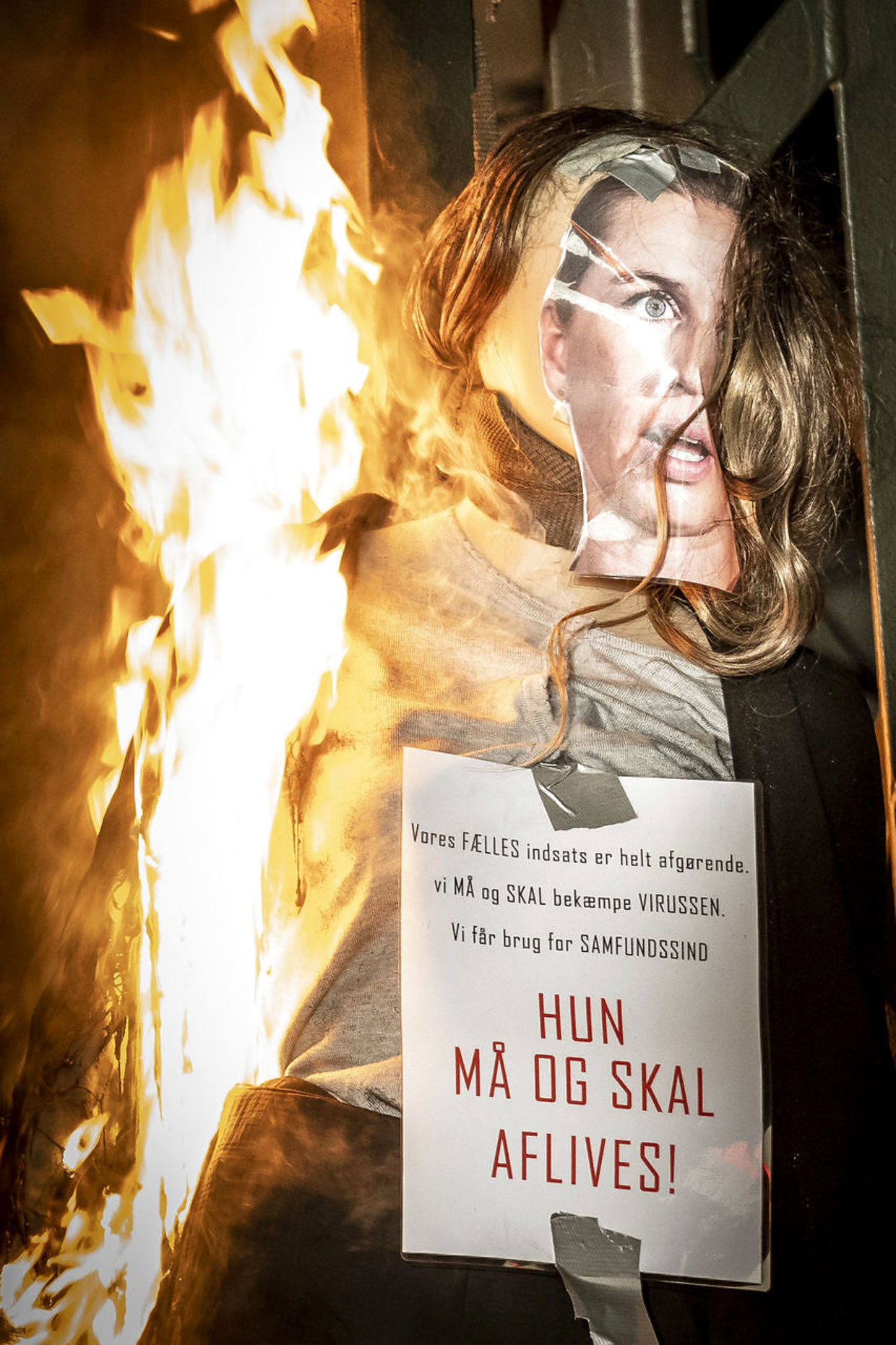
As the situation improved, an increasing number of people have been agitating to allow stores, small businesses and schools to open up. Demonstrators from the Facebook group Men in Black have clashed with police and burned Prime Minister Mette Frederiksen in effigy (DK) with the slogan “she must and shall be put down,” that is, euthanized. Another Facebook group planned a coordinated business opening in defiance of the rules.
22 February 2021
Coronavirus DK: Outbreak of B117 at schools
As the situation improved, an increasing number of people have been agitating to allow stores, small businesses and schools to open up. Demonstrators from the Facebook group Men in Black have clashed with police and burned Prime Minister Mette Frederiksen in effigy (DK) with the slogan “she must and shall be put down,” that is, euthanized. Another Facebook group planned a coordinated business opening in defiance of the rules.
21 January 2021
Danish reactions to Biden’s inauguration
17 December 2020
Coronavirus DK: Lockdown redux
Like most other Western European countries, Denmark is going back into total lockdown. On Wednesday, Prime Minister Mette Frederiksen and the pandemic task force held another press conference (DK) to announce further restrictions beyond the ones implemented last week. “We are doing it,” said Frederiksen, “because an epidemic that runs out of control will have serious consequences and more serious consequences than closing down now will have.”
![]() |
| Mette Frederiksen and Magnus Heunicke at press conference. Photo: Mads Claus Rasmussen © Scanpix. |
Record-high infections
The risk rating for the entire country was raised to 4, the second-highest level. On the same day as the press conference, the State Serum Institute reported the highest number of infections ever, 3,692. More than 22,000 cases were registered in the past week, and hospitalizations rose by 54 to 493.
The following additional organizations and activities were ordered to close (DK) during the coming week:
- Beginning today, Thursday, the 17th, shopping centers and department stores.
- Beginning on Monday, the 21st, boarding schools; and small businesses; and the remaining elementary school pupils, from kindergarten to the fourth grade. Other students had already been attending classes online.
- From December 25 to January 3, all retails shops except supermarkets and pharmacies.
Christmas not canceled
The limit on gatherings is unchanged at ten, but Frederiksen urged people to limit Christmas festivities as much as possible. Earlier, the State Serum Institute estimated that the Christmas holidays would cause the number of infections to double. Certain researchers have recommended closing the Great Belt Bridge, which connects Zealand to Funen and Jutland, in order to prevent the virus from spreading from the hotspot of Greater Copenhagen. The government has decided against it, however, because Christmas is a “special holiday,” said Søren Bostrøm, head of the Healthcare Authority. The police noted their concerns about New Year’s Eve, warning people not to gather at the traditional locations such as Copenhagen City Hall Plaza.
Exception for daycare centers
The only major institutions that aren’t closing are daycare centers, and the leaders and staff are complaining (DK) about it. Children do not often get sick, but they infect their parents, they note. Many staff members are sick or quarantined, putting more pressure on those who remain. The government’s rationale, according to Magnus Heunicke, Minister of Health, is that someone has to take care of the children of essential workers, such as healthcare staff and the police, and the Health Authority does not consider the risks at daycare centers to be high. “The healthcare system is under pressure,” said Bostrøm, “and we need to prioritize so that the staff can take care of the sickest patients.” That means, among other things, that elective surgery may be postponed until January.
Frederiksen doubts that these latest measures will have a significant effect on the Danish economy, which has performed better in 2020 than had been expected during the lockdown in the spring. The government is already at work on a new relief package for businesses and employees who are affected by the lockdown.
18 November 2020
Coronavirus DK: Of mink and ministers
Like most everywhere else, Denmark is suffering from the second wave, but it is much milder here than in the larger European countries and in its misguided neighbor Sweden. That hasn’t prevented a political scandal about what should have been a secondary issue, though.
![]() |
| Mink enjoying their last days in captivity. Photo: Mads Claus Rasmussen © Scanpix. |
First, an overdue summary of the health situation (DK):
- Cases of infection (yesterday/total): 1,220 / 64,551 (800-1,200 in past month)
- Tested (yesterday/total): 68,750 / 6,455,895
- Hospitalized (yesterday/total): net -8 / 259
- Intensive (yesterday/total): net -3 / 41
- Recovered (yesterday/total): 1,265 / 49,961
- Deaths (yesterday/total): 4 / 768
- Percentage of positive tests: 1.6% (1.3%-1.9% in past month)
- Reproduction number (est.): 1.1
- Deaths per million: 133 (vs. Norway 55; Sweden 614; USA 751; UK 772; Italy 755)
And a summary of the restrictions in effect (DK):
- Face masks required on public transportation, in public buildings, in supermarkets and shopping centers, at doctors’ offices, clinics and hospitals; partial requirement at schools and other educational institutions.
- Limit on gatherings to 10 people in public places; recommended also for private gatherings.
- Limit of 500 people at sports events, concerts and churches.
- Restaurants and bars close at 10 pm. Masks required except when sitting down. Nightclubs closed. Sale of alcohol banned everywhere after 10 pm.
- The municipalities in northern Jutland that were closed for travel have reopened.
Minkgate
The big story of the past week or two has been the government's handling of the infections discovered at mink farms in Jutland. It has been well-covered in English-language media. The story morphed from being about the health threat of the outbreak to a scandal about Prime Minister Mette Frederiksen’s premature and illegal order to destroy 15 million mink and then Agriculture Minister Mogens Jensen’s apparent disregard for several warnings about the spread. Frederiksen has rescinded the order and apologized, and the government has reached a compromise on culling the mink and compensating the breeders, although the measures have not been enacted yet and Opposition parties have been critical of the entire series of events.
Agriculture minister and chickens also face termination
Denmark is the largest mink fur exporter in the world. Kopenhagen Fur (DK), the auction house for some 1,500 breeders in Denmark, recently announced that it would close over the next two or three years. In the spring and summer, Frederiksen enjoyed high approval ratings for her handling of epidemic and withstood criticism of the lockdown from the business-friendly right-wing parties. Now it appears that more people are suffering “corona fatigue” and are also tiring of her relatively autocratic style of governing. Even the government’s supporting parties are saying that Jensen should resign (DK).
On top of this came a discovery of serious cases of bird flu (DK) earlier this month. Some 25,000 chickens have been culled, and exports of chicken and eggs outside the EU have been suspended. This outbreak poses no threat to humans.
27 July 2020
Coronavirus DK: Reversals in both Lockdown-gate and EU deal
![]() |
| Kåre Mølbak at a coronavirus press conference. Photo: Niels Christian Vilmann, Ritzau Scanpix. |
Now Kåre Mølbak, the director of Statens Serum Institut (SSI), the agency responsible for preparedness against infectious diseases, says in an email to the daily Politiken (DK, paywall) that he supported the administration’s decision. Mølbak was also one of the administration’s closest advisors during the worst period of the epidemic and appeared with Frederiksen and Brostrøm in several press conferences.
An “authority” comes forth
“For me it was essential that the government was prepared to maintain the comprehensive effort that was presented to me on March 11 until after Easter,” wrote Mølbak. “According to SSI’s assessment, this long-term perspective was necessary in order to bring the epidemic under control.”
In his March 11 email, Brostrøm had stated that he had “discussed” his conclusion with Mølbak, but Mølbak now says that at the time he did not share Brostrøm’s concerns about a lockdown. So it appears that Frederiksen has acquired at least one “authority” for her policy and may therefore escape the insinuations of dishonesty and deceit from the opposition parties that became more pointed after the disclosure of Brostrøm’s email.
Don’t celebrate yet, prime ministers
The historic agreement that European Union leaders recently reached on the next seven-year budget and emergency pandemic aid for southern Europe is now in doubt. The deal must be approved by the European Parliament, and at present, a large majority of the Parliament is against it. They voted 465-150 for a provisional resolution to reject the budget (DK).
They have several reservations. According to Manfred Weber, the chair of the Christian Conservative group, the Parliament’s largest bloc, more money in the budget should be directed toward research, healthcare and the EU’s outer borders. Along with other factions, Weber also insists that the disbursements to member states be contingent on adherence to the “European spirit,” that is, to democratic principles.
No money for autocrats
“It is completely clear for us socialists,” said Iratxe Garcia Perez of the Social Democratic group, “that not a single euro should go to the governments that do not fully respect the rule of law and the fundamental values of the Union.” These are allusions to the infringement of freedom of the press and judicial independence in Hungary and similar tendencies in Poland. Those two countries succeeded avoiding immediate sanctions that affect their receipt of EU funds.
The resolution isn’t binding. The final vote is not scheduled to take place until the end of September.
Editorial note
You may have noticed that the news about the epidemic in Denmark has become less dramatic in recent weeks as the spread of infections remains under control despite the gradual relaxation of lockdown restrictions. There is no longer much need for these updates on a daily basis, so from now on, they will appear less frequently and may treat other topics besides the coronavirus. If there is a second wave that causes great disruption again, as is happening now in some locales, they can resume. Stay tuned, and thanks for reading.
26 July 2020
Coronavirus DK: Justification for lockdown questioned again
![]() |
| Prime Minister Mette Frederiksen. Photo: Niels Christian Vilmann © Scanpix. |
At the press conference, Frederiksen said that she was ordering the lockdown “on the recommendation of the authorities.” She has been questioned about the decision earlier. At a meeting requested by the opposition parties held on June 9, she reiterated that it was based on the recommendations of a “broad group of authorities” without specifying who or what she was referring to. The issue is important, says Sten Brønsing, Professor of Constitutional Law at Aalborg University, because ministers may not justify political decisions (DK) on the basis of recommendations of government officials if such recommendations have not been made.
Come clean, Mette
Now three opposition parties are demanding a clear explanation (DK): “We hope that she will realize on her own that it is reasonable to explain to the Danes why she said something that is not true,” says Peter Skaarup, leader of the Danish People’s Party parliamentary group. The effect of Frederiksen’s press conference was to “deceive the Danes,” continues Skaarup. “It cannot be interpreted otherwise.”
(Commentators have noted that both the administration and opposition parties have begun referring to the population as “the Danes” rather than “citizens” or “people.” Some have attributed populist, even subtly racist intentions to this usage, which might imply that a certain segment consists of real, ethnic Danes.)
Ratcheting up the rhetoric to “not honest”
The Liberal Party is demanding a written report (DK) from the prime minister and threatening to call for another investigatory meeting. “It is wrong that the prime minister in the beginning was not honest and did not say that this was a political decision,” says Karen Ellemann, the acting political spokesperson for the Party. “We have asked several times who had recommended [the lockdown].” The Conservative Party is also criticizing Frederiksen for not being forthcoming.
In none of these accusations did the opposition say that the lockdown was wrong or was a bad decision. They did not contain any evaluation of the administration’s lockdown policy itself or its consequences in comparison with results in countries that did not implement similar restrictions. The opposition pressured the government to relax restrictions earlier than it had planned, but Frederiksen has had a high approval rating in opinion surveys throughout the crisis.
She is away on vacation at present. Her office refers inquiries to the explanation given at the June 9 meeting. Parliament has appointed a commission that will evaluate the entire management of the coronavirus crisis.
12 July 2020
Coronavirus DK: Big shifts in trust in government and the US
One is the annual Tryghedsanalyse (DK) (security survey) conducted by a foundation associated with the Tryg insurance group. It gathered data from both before and after the onset of the coronavirus crisis, ending on May 22. It showed, among other things, that 84 percent of Danes surveyed were very or fairly satisfied with the government’s management of the epidemic. That was the highest rating of any European country. Norway and Finland came next. Toward the bottom were Sweden (55 percent), the UK (45 percent) and France (37 percent). Confidence in all public institutions rose, not only the administration and Parliament but also the police, the courts and the EU.
Rising to the occasion
In a column on Altinget.dk, Lisbeth Knudsen (DK), former editor in chief of a major daily, calls this a significant change in recent Danish politics. It begins, “For years we have discussed what would be necessary to turn around the public’s worrying and growing lack of confidence in politicians. . . . We now have the answer: an enormous, comprehensive health care crisis.” The pandemic showed that the government could respond effectively and collaborate constructively with other parties in Parliament, without the usual bickering and personal attacks.Prime Minister Mette Frederiksen succeeded in presenting a narrative that appealed to the country’s social democratic principle of solidarity at a time when many were more insecure than ever about losing their jobs, partly by emphasizing an obligation to protect those who were most vulnerable to the virus. The crisis has strengthened the Social Democrats’ standing in polls, and it has also forced the opposition to take an approach based more clearly on solutions and new ideas rather than tactical criticism.
Litmus test for the world
The results of the poll show an extreme contrast with Donald Trump’s current record-high disapproval rating and Americans’ growing distrust in government. The pandemic has served as a sort of acid test that throws the strengths and weaknesses of all countries into stark relief. This reflects not only on their leaders but also their institutions, such as the CDC, which bungled the testing at the outset of outbreak, despite all its plans and resources.Former enemy overtakes Cold War champion
The other survey, which was conducted by the independent research institutes Moos-Bjerre and Userneeds and whose results were released in Weekendavisen (DK, paywall), concerns Denmark’s international security alliances. It has more direct relevance to the US, which has been Denmark’s most important ally throughout the Cold War and after. The poll shows that now only 40 percent of Danes surveyed agree with the statement “The USA is Denmark’s most important ally,” while 54 percent now assign that role to Germany.In addition, 65 percent believe that “In the future, Denmark should give priority to collaboration with the other EU countries over collaboration with the USA.” These are historic shifts, and somewhat surprising, since Germany is no military power and Denmark has often taken a dissenting position in the EU, regarding immigration and shared debt for example.
How much blame does Trump deserve?
One can debate how much the development is owing to Trump and his myopic nationalism, particularly his threats to leave NATO. For a while after Trump’s election, most Danes probably agreed with former Prime Minister Lars Løkke Rasmussen that “The USA is Denmark’s most important ally – no matter who is in the White House.” Brexit may also have nudged Denmark closer to its continental European neighbors, and Emmanuel Macron’s tribulations may have left Angela Merkel as the clearest leader of what used to be called “the Free World.” But Trump has undoubtedly soured Danes' perception of the US, even though it remains the only superpower in the West.06 June 2020
Coronavirus DK: Pop the champagne, play ball, and defend Greenland
Stay in your seats
The most important exception to the limitations concerns the first phase. The government will allow up to 500 persons to attend an event if the participants are sitting down, for example at a soccer match in a stadium, at a wedding reception in a restaurant, and at an annual general meeting in a conference center, as well as for summer activities for children. The increase to 200 in August will be allowed only for events that are arranged in accordance with “sector partnership guidelines.” The proposal also contains an extension of the limit on space for individuals in private businesses – that is, of one person per 2 square meters – to apply to all locations where attendees are sitting down. The parties had agreed on a general intention to ease the limit on gatherings at earlier negotiations in May.The proposal does not cover indoor sports, fitness centers and swimming halls. Negotiations on those activities, which are subject to one of the last remaining prohibitions, are also supposed to be completed by Monday.
Grudging acknowledgment
The other parties were pleased with the news. “It’s about time that the government made this announcement,” said Kristian Thulesen Dahl of the Danish People’s Party, which has wanted people to be able to hold receptions and large parties, which will also help restaurants recover some of their usual revenues. Sophie Løhde from the Liberal Party wished the announcement had come earlier because uncertainty about the prohibition might have caused some people to cancel their wedding plans. She also wants soccer clubs to receive compensation if they normally attract more than 500 spectators. The government’s supporting parties also think the proposal is sensible, adding that they depend on the continued observance of hygienic recommendations as well as contact tracing and isolation of infection cases.Not him again
If this weren’t enough good news for Constitution Day, Denmark, via the person of Queen Margrethe, received congratulations from an unexpected quarter (DK), none other than the national leader whose reputation has sunk to the most horrendous depths this week. Trump’s people took the time to make this gesture on a day when the president was busy saying that this was "a great day for [George Floyd]" because the unemployment rate fell for the first time since the pandemic hit. The message also mentions the reopening of the US Consulate in Greenland, a reminder of the country’s security interest in the region and Trump’s offer to buy the autonomous territory last year, which was rejected as “absurd” by PM Frederiksen.Commentator Troels Mylenberg notes that especially on Constitution Day such congratulations should have been directed toward the democratically elected Parliament rather than a monarchic figurehead and that they wouldn’t have come at all if Trump wasn’t still interested in expanding US activities in Greenland. The message appears on the US Embassy’s website beside an alert about demonstrations against police brutality and racism that will be held in front of the Embassy this weekend.
05 June 2020
Coronavirus DK: Happy Constitution Day, let's party!
When the coronavirus hit, Frederiksen appealed to the population with the traditional social democratic values of a strong welfare state, especially the healthcare sector, and solidarity across classes in the common cause of containing the epidemic. She was considered almost authoritarian in her adherence to the precautionary principle during the lockdown phase, but her popularity soared. Although the government’s policy was criticized by the right-wing parties and the private sector for being too hard on the economy, Frederiksen won admiration even from former critics for her consistency and ability to communicate effectively to the citizenry.
Triumph of the welfare state
The Social Democrats are now polling at 34 percent (DK) of the electorate, a level they haven’t seen for decades. National leaders almost always see a boost in popularity during a crisis, but Frederiksen has maintained her support even after segments of the population began to express impatience with the gradual reopening of the economy and disclosures of the government’s rejection of the Health Authority’s recommendation came to light. According to political commentator Erik Holstein, “The Social Democratic Party has succeeded in creating a story that the solution to the coronavirus crisis is the social democratic welfare state.” Holstein expects the polling number to decline somewhat but thinks there is a good possibility that the party can retain some of its new adherents and regain its clear position as the country’s largest party.Celebrating Constitution Day on Zoom
Denmark has seen some protests against the lockdown that claim that the threat of the coronavirus has been vastly exaggerated and the government is using the crisis as a pretext to implement authoritarian controls on the population. But such charges bordering on conspiracy theory have never gained a substantial following. On the occasion of Constitution Day, however, the issue is being raised in another quarter, the Institute for Human Rights (DK). Louise Holck, the head of the organization, notes that this year Constitution Day must be observed in a different way than usual because our freedom of assembly is being limited.Holck asks how long Danish citizens’ rights should be restricted as drastically as they have been during the crisis. The right to assembly is one of the fundamental rights in a democratic society, and it is closely related to the essential right to expression. It is in gatherings that citizens express and exchange ideas. The Constitution says that citizens “have a right to gather unarmed without advance permission.” It says nothing about restrictions on peaceful gatherings, but the prevailing interpretation is that such restrictions should be “necessary and proportional.”
Speed up the reopening
Holck does not deny that the limitation on gatherings was necessary when the lockdown was announced on March 13 and while the epidemic continued to pose a clear threat to the population. Her position is similar to that of conservative party leaders, who questioned only the extent and duration of lockdown. But now, as the number of patients hospitalized has fallen below 100 and the economy is reopening, the restriction no longer seems "proportional": “It is harder and harder to see the justification for maintaining a ban on gatherings as small as 11 persons.”The government has said that it will consider raising the limit on gatherings this month.
30 May 2020
Coronavirus DK: Clash over plan for border opening
Beginning on June 15, tourists from Germany, Norway and Iceland may enter Denmark, but they must be able to document that they have booked a stay for at least six nights outside of Copenhagen. They may make day trips to Copenhagen, which has had by far the most infections in Denmark, but must sleep elsewhere. Germany has had an infection rate similar to Denmark's, and the rate in the two other countries has been lower.
Tourists from other countries, including Sweden, are excluded. Officials in Sweden, which has not had a strict lockdown and has a much larger number of infections, have complained about lack of access to Denmark. Many Swedes work in Denmark, and many Danes have summer houses in southern Sweden. After the summer, the government expects to open the border to Schengen countries and the UK, said Frederiksen. She added that it may try to find a regional solution to the issue of Sweden.
No Mediterranean beaches for Danes
Tourists will be asked to be tested for the coronavirus when they cross the border, but it will not be compulsory. If they have visible symptoms, they will be refused entry. There will be test centers at popular vacation spots, and if tourists test positive, they may stay in the country subject to the Health Authority’s general guidelines on isolation.For people traveling abroad from Denmark, the same restrictions apply. On June 15, they may travel to the same three countries, where they are urged to avoid large cities. The government advises against travel to other countries until August 31. That includes countries in southern Europe where many Danes spend their summer vacations. Frederiksen expressed regrets (DK) that people cannot travel to warm beaches and urged them to vacation in Denmark this year and help support hotels, restaurants and other local tourist sites that are suffering economically because of a lack of customers. If people travel to other countries, they may be subject to restrictions there or become stranded. In any case, they are urged to quarantine themselves for 14 days when they return.
SSI, the agency for preparedness against infectious diseases, believes that the border opening will lead to an increase in the number of infections (DK). It estimates that 400-1,500 asymptomatic persons with the coronavirus will enter the country. Independent healthcare researchers were divided (DK) about the plan. Some think it is sensible, and others believe that tourists from additional countries should be allowed entrance.
Strange, incomprehensible, shocking
Not surprisingly, the plan drew criticism from the opposition (DK), which has been agitating for an earlier border opening. Jacob Ellemann-Jensen of the Liberal Party calls the restrictions in the plan strange and arbitrary: “Why is it six days? And what is so dangerous about sleeping in Copenhagen? It is hard to see the rationale in the necessity of hurting hotels in Copenhagen and Frederiksberg. I hope there is a justification on the basis of healthcare considerations.”Criticism also came from Frederiksen’s fellow Social Democrats. “Sad and incomprehensible,” said Jonas Bjørn Jensen, spokesperson for the party in Copenhagen. “It is Copenhagen that generates the most money for tourism, so if you want to benefit the industry, you should start there.”
Representatives of the tourism industry of course agreed. “I am shocked,” said Peter Haaber, head of the Zleep Hotels chain. “It is almost a compulsory lockdown.” The head of VisitDenmark, Jan Olsen, however, acknowledged the loss of income to hotels in Copenhagen but noted that only about 10 percent of tourists from the three countries in question stay in the city. Most stay along the coasts, and they have already begun to book rooms.
28 May 2020
Coronavirus: More doubts about government’s communications
This disclosure came soon after the news that immediately before Frederiksen’s announcement the Health Authority had not recommended the restrictions that the government implemented. A spokesperson for the Liberal Party, the largest opposition party, accused Frederiksen of “speaking untruthfully,” and Frederiksen maintained that the government had followed broad recommendations of the authorities. Between Brostrøm’s March 1 email and the March 11 announcement, the number of infections in Denmark rose from four to 514, and the latter figure was later adjusted to 758.
Withheld good news
On Wednesday, another story appeared that raises doubts about the government’s communication of information from the Health Authority. It appears that the government held back news of a positive development (DK) in the spread of the virus until after it had extended the lockdown. On March 20, Brostrøm sent another email, this time to his colleague Kåre Mølbak, saying that the reproduction rate of the infection had fallen from 2.6 to 2.1. He thought that the information should be announced publicly on the same day but reported that a political decision was made to withhold it until March 23.“The population has had a great deal of confidence in the authorities and the government,” said Martin Geertsen, the healthcare spokesperson for the Liberal Party. “One can only say that the confidence doesn’t go in the other direction. … The government and the prime minister are apparently of the opinion that there is information that the public cannot bear to hear.” After the earlier revelation, the party called for an official consultation with the government on the issue.
Mistakes will occur
Also on Wednesday, Culture Minister Joy Mogensen acknowledged that at the beginning of the coronavirus crisis, the Ministry of Culture did not have a right to prohibit a large number of employees (DK) at the Danish Broadcasting Corporation and the TV2 news service from working. The order applied to all employees at the media organizations except for news journalists. It came on March 11, when the government announced that civil servants who did not perform essential functions should not report for work. Mogensen regretted that the announcement was expressed as an order and not a recommendation: “We have always been open to the fact that this was a completely unusual situation and that because of time pressure mistakes would occur.”Alienating allies
As the conservative commentator Jarl Cordua wrote yesterday, Frederiksen and the Social Democratic administration have attained historically strong support from the population during the pandemic but their tendency to act independently has brought the opposition together (DK). Although they have managed to react quickly to their own mistakes and miscommunications and thus reduce the political damage, they have driven one of their supporting parties, the Social Liberals, into an alliance with the right-wing parties, particularly on the issue of reopening the borders. This makes it more obvious that it is a minority government, and the opposition will take advantage of opportunities to press its criticism of the government’s management of the pandemic.23 May 2020
Coronavirus: PM's justification for lockdown questioned
Not the Health Authority
The day before the press conference, the Health Authority compiled a list of possible measures to take against the virus, and a lockdown and forcible intervention were not mentioned. A memorandum dated February 28 from Søren Brostrøm, the head of the Health Authority, indicates that the Authority was against a general intervention upon citizens’ freedom and that such measures should be permitted only in certain “specific situations.” In the March 11 announcement, Frederiksen did not say which authorities had made the recommendation.Kjeld Møller Pedersen, Professor of Healthcare Policy at Southern Denmark University says that “the government has misused the healthcare advice.” The day after the press conference, Parliament passed an emergency bill that gave the government power to dictate policy instead of the Health Authority. “It was not a pretty process,” says Kent Kristensen, Associate Professor of Healthcare Law at Southern Denmark University.
Now representatives of various political parties want to question Frederiksen about the process. Sophie Løhde from the Liberal Party says that “the prime minister has spoken untruthfully directly to the Danes.” The Social Liberals and the Red-Green Party, which support the administration, also want an explanation.
Administration defends the decision
Later on Friday, when she visited a museum that was reopening after two months, Frederiksen spoke to reporters about the accusations (DK). She said that government authorities recommended a partial lockdown of the country in order to minimize social contact. When asked which authorities did so if the Health Authority apparently did not, she said, “It was a broad group from the authorities that has advised us. And as a general principle, I won’t get into which words came from which authorities. . . . Specifically, how we closed Denmark and that we did it quickly were of course political decisions.”In a written response to inquiries, Minister of Health Magnus Heunicke stated that “On the basis of an overall evaluation, the government made a decision according to a precautionary principle to close down all unnecessary activity in society.”
Any practical significance?
The healthcare spokesperson for the Liberal Party, which has been most critical of Frederiksen’s sometimes autocratic handling of the crisis, does not question whether the lockdown was the right decision (DK) but maintains, like several other parties, that the entire process should be investigated thoroughly after the crisis has passed.The Ritzau agency was unable to get a comment from the Health Authority, which was closed because of the Ascension Day holiday. The story does not seem to be given much prominence in the main media sources. It appears very far down Danish Broadcasting Corporation’s home page (DK), for example.
21 May 2020
Coronavirus DK: Speeding up the reopening
This means that almost everything that still had been closed can reopen on the condition that they observe the guidelines on hygiene and social distancing. The only exceptions are gyms and other indoor sports and recreational activities, nightclubs and concert halls, and institutions of higher education that have not already opened as well as public-sector offices in Zealand. This is the first time the reopening plan has differentiated between the policies for individual regions.
The change in the timetable was made possible because of a new report from Statens Serum Institute (SSI) showing that the infection rate in the country remained low despite the relaxation of lockdown restrictions.
Partying can wait
The parties also agreed raise the limit on gatherings gradually to 30 to 50 persons during the summer, beginning with the transition to phase 3 on June 8. On May 25, the borders will open (DK) for residents of the other Scandinavian countries and Germany who own a summer house or have relatives in Denmark, and a plan to open the borders further for foreign tourism will be announced by May 29.A majority of Parliament consisting of the right-wing parties, the Social Liberal Party and the Alternative Party had pressed the government especially to open the borders (DK) and to increase the limit on gatherings before the end of May. The SSI warned particularly against large indoor gatherings. When people are together for an extended period without adequate ventilation or the liberal consumption of alcohol makes the observance of precautionary guidelines more difficult, there is a risk of “superspreading” (DK).
Tourists can wait
“The border is the factor that has the greatest economic significance for Denmark right now,” said Jacob Ellemann-Jensen of the Liberal Party. The right wing received support for this position from the WHO (DK), whose spokesperson recently stated that because of its progress in controlling the virus, Denmark should be able to open its borders, assuming that it does so carefully, for example by screening tourists.The report from the SSI warned that opening the borders posed a risk of starting new chains of infection. Pernille Skipper of the Red-Green Party agreed, reminding the others that the Health Authority had advised allowing for three weeks between phases of reopening in order to monitor the spread of the virus.
The WHO vs. Mette
Prime Minister Mette Frederiksen has thus far resisted the economic arguments for large events and open borders. “When you come into Christiansborg [Parliament], you almost get the impression that we have left corona behind us,” she said. “If Denmark has a prime minister who lets herself be pressured into something that isn’t defensible, it simply won’t work. And it won’t happen with me.”15 May 2020
Coronavirus DK: Ten politicians miss hugging
Tax break, opening the border
Before the debate Ellemann-Jensen had proposed reducing VAT by 50 percent (DK) in the second half of 2020 as a way of creating jobs. The move would lower prices for consumers and help businesses recover. VAT in Denmark is 25 percent, and the reduction would put the VAT rate below the EU’s minimum level. Ellemann-Jensen raised this issue in the debate, but got no immediate support from the other right-wing parties. Morten Østergaard of the Social Liberals supported a tax break for businesses but wanted the initiative to take the form of a permanent “green conversion” (DK) that advanced sustainable energy rather than a temporary rescue measure.Østergaard also pressed Frederiksen on opening the border (DK) at least for German summer tourists in order to boost the rural economies that depend on summer tourism. Germany is opening its borders today and has invited Denmark to join it. Frederiksen said that the government was willing to consider the possibility but warned of the consequences if a German family proved to be spreading the virus and reiterated the government’s intention to wait until June 1 to present a plan for the borders.
Frederiksen in charge
Altogether, there was little new in the debate and not much disagreement. It concluded with the party leaders saying almost unanimously and sometimes emotionally that they looked forward, after the crisis has passed, to being able to give their parents and others a proper hug again (DK). The most noteworthy pronouncements perhaps came before the debate began, when Frederiksen was on her way into the National Gallery, where it was held. Earlier in the day, Frederiksen had sent an email to the party leaders with a new, more optimistic report from SSI, the agency responsible for preparedness against infectious diseases, and an invitation to negotiations on accelerating the reopening. On the way to the debate, she announced that she thought the reopening should proceed more quickly. She thus seemed to take credit for something that many of them had argued for and left them with few options in their response.The sharpest exchange (DK) of the evening also occurred during Frederiksen’s preliminary colloquy with journalists. When asked whether it was wise to frighten people in the beginning of the crisis by referring to images of Italian trucks carrying corpses, she replied by asking the reporter, Henrik Qvotrup of the tabloid Ekstra Bladet, whether he was certain that things wouldn’t have gone wrong if Denmark hadn’t locked down earlier than other countries. “But you’re the prime minister and I’m the journalist,” Qvotrup answered. “That’s maybe a very good thing for the Danish people, if I may say so,” replied Frederiksen. One commentator remarked that the irritated response indicated that the issue of whether Frederiksen has overdramatized the dangers of the epidemic must be a sore point for her.
30 April 2020
Coronavirus DK: The "Covid bloc's" sickly dissent
Inconsistent policy on reopening
The right-wing parties have been pressing for an earlier opening of businesses and other institutions. Jakob Ellemann-Jensen, the chairman of the Liberal Party, noted that people with medical conditions unrelated to Covid-19 were not able to get treatment because of a prejudice toward private hospitals on the part of the government. He said that the reopening has not been “controlled” as it was supposed to be. It has rather been arbitrary, with shifting policies, and businesses must guess the cabinet ministers’ mood if they do not want to be shamed for reopening even under legal conditions – an allusion to the controversy over IKEA’s reopening on Monday. Søren Pape Poulsen, the chairman of the Conservative Party, said that the testing policy has been confusing because it appeared that it was determined by a shortage of equipment rather than principle.When asked whether businesses would suffer if the relaxation of restrictions went too slowly, Frederiksen reasserted the government’s position that the process must be done gradually and carefully. She underscored the five main elements of the regimen: more extensive and aggressive testing and tracing; continued use of protective equipment, for example when people visit older relatives; frequent, thorough cleaning; routine social distancing in workplaces and schools; and prevention of “superspreading” in large gatherings such as concerts.
Illness close to home
In the middle of the session, Frederiksen suddenly left Parliament (DK) because she had gotten a message that a family member had fallen ill, and she was driven directly to Herlev Hospital. Later she posted a message on Facebook saying the situation was not serious and she looked forward to continuing negotiations the next day. She didn’t say whether the illness was related to Covid-19.The “Covid” opposition
On Thursday, political commentator Lars Trier Mogensen, the editor of the newsletter dkpol, wrote that the current parliamentary opposition was the weakest (DK) in this century. He called it the “Covid bloc.” Danish parties are identified by single letters on voting ballots, and the right-wing parties’ abbreviations, beginning with C for the Conservative Party, by an odd coincidence happen to spell “Covid.”In his trenchant analysis, Mogensen wrote that it might seem as though the bloc had been bewitched and paralyzed by the corona virus because since the crisis Prime Minister Mette Frederiksen’s Social Democrats have become more popular than ever in recent times and their own standing in opinion polls has fallen sharply. But he hastens to add that the right wing’s decline had been underway before the corona virus came to Denmark, for several reasons. For example, the Social Democrats have moved to the right and preempted much of their traditional platform, leaving them with no distinctive positions on either cultural values or economic reform – in “psychic quarantine.” In any case, despite its complaints about the details and pace of the process, the bloc is unable to offer any meaningful counterpoint to the government’s handling of the pandemic.
17 April 2020
Coronavirus in Denmark: Normalization proceeds apace
Time for that overdue haircut
The revised guidelines take effect on Monday, April 20. The main economic segment that can resume activities is professional services and certain small service businesses such as hairdressers and driver education. Courts and research laboratories can also open on April 20. The agreement allows for initiatives to resume visits to the elderly and provide support for distressed children and families. The agreement also calls for the establishment of “sector partnerships” under which other industry associations and organizations can negotiate with the authorities on the timing and degree of reopening. The SSI recommended against opening restaurants and boarding schools.As an adjunct to the relaxation of restrictions, SSI set forth a strategy for testing frontline staff, vulnerable groups, relatives of patients, and representative sample of the population in order to monitor the spread of the infection. Negotiations on phase two of the reopening will begin next week.
Both the administration and the SSI stress the importance of continuing social distancing. Some observers, for example Allan Randrup Thomsen, Professor of Experimental Virology at the University of Copenhagen, warn that there is a danger that people will interpret the expanded reopening plan to mean that the danger has passed and that they can resume their old habits. SSI’s memorandum (DK) showed estimates of the number of hospitalizations if the population continued to practice social distancing, if only half practiced it, and if none did. Even under the second scenario, with half the population adhering to the guidelines, the number of hospitalizations and ICU patients would continue to decline. According to the SSI’s model, if professional services resume normal activities, the chances that in three months hospitalizations would be above the current level was less than 20 percent.
Nurseries without teddy bears
On Wednesday, many schools and day-care centers across Denmark reopened. About half of the municipalities requested additional time before opening. Children were described as being happy to see their friends again but sometimes disappointed that they couldn’t hug. Teachers and day-care staff were adjusting to the new guidelines, for example that desks are two meters apart and pupils could not gather in groups of more than two inside and five outside.The kindergartens and nurseries were struggling with the extensive rules on limiting contact. For example, parents could not enter the facilities, and children could not bring extra clothing or their own teddy bears and toys. They had to sit two meters apart and were allowed to play only with plastic toys that could be washed frequently. Staff meetings have to be held outside or by telephone. Denmark is the first country in Europe to reopen its schools. Austria, which allowed the resumption of small businesses this week, will not reopen the schools until next month.
09 April 2020
Coronavirus in Denmark: Preparing for reopening
Prime Minister Mette Frederiksen (DK) said that is the next phase will be just as difficult as the past month. It is important that the reopening takes place in stages so that the authorities can follow the development of infections and cautiously so that the country does not risk wasting the progress made in the lockdown.
Director General of the Danish Health Authority Søren Brostrøm (DK) was asked whether he could promise that the infections will not get out of control after schools and day-care centers reopen next week. He warned that they could if everyone does not continue to follow the government and Health Authority’s recommendations on social distancing, washing hands, etc. Reiterating the PM’s exhortation, he said that people must demonstrate over the Easter weekend that they can maintain their discipline because it is our collective responsibility to make the controlled reopening a success.
Not so fast
Meanwhile, there are several other developments as the country moves toward the next stage of the epidemic.Most of the country’s 20 largest municipalities report that they are not ready to reopen (DK) their schools fully on April 15. The schools and day-care centers need to make new arrangements in order keep the children at distance from one another, to clean the facilities more frequently than usual, and so on. Fourteen of them say if they reopen on the target date they will need to do it gradually because they cannot manage the usual number of children.
A few days ago, there was a report on the percentage of blood donors who were found to have coronavirus antibodies, and it was used to make an estimate of the actual number of infections above the official figures. Since then there has been a boom in blood donations (DK) because people want to find out whether they have been infected and developed immunity. Officials explain that, while testing for antibodies gives a rough indication of the spread of the virus in the general population, it is not intended to determine whether individuals have antibodies and the individual tests are not reliable. The first results from testing on Monday were presented yesterday. They showed that 22 of 1,487 tested positive for antibodies. That would correspond to 127,000 infected persons in the country, as opposed to the 5,386 confirmed cases.
New monitoring tool
I wrote a few days ago that a group of IT people had launched a volunteer initiative to develop a self-reporting tool to monitor people’s symptoms (DK). Yesterday, the Ministry of Health unveiled its own solution for the same purpose, Covidmeter. As many people as possible are urged to report once a week on their health status, their contacts and whether they have been tested. The information will give the authorities a better idea of whether the level of infections is being kept at a manageable level. You can access the reporting app with a secure logon at sundhed.dk (DK), and the information is anonymized.Hospitals may not be able to care for all of their patients because of extra cases of Covid-19. General practitioners have offered to take on patients and complete their treatment if they need to leave the hospital early. According to an agreement between the Danish Medical Association (PLO) of Zealand and the Zealand Region, they will charge double their normal fees (DK). This has been criticized for being greedy and unsympathetic by spokespersons of the parliamentary parties across the political spectrum. A PLO representative defended the agreement as fair because of the degree of responsibility entailed and added that GPs have seen their income decline about 40 percent during the crisis.
European solidarity
On April 1, Italy sent a request to Denmark for help in managing the Covid-19 outbreak. Yesterday, the administration announced that it would send Italy aid (DK) in the form of a number of respirators, an unstaffed field hospital and EUR 1 million to be used for protective equipment and ambulance operations.(Note: During the coronavirus crisis, this blog has become daily digest of news from Denmark. Since the situation has stabilized, it will probably also take an Easter break for the next couple of days unless there is something urgent to report.)