Nav Menu (Do Not Edit Here!)

Home     About     Contact
Showing posts with label travel. Show all posts

29 January 2021

Coronavirus DK: Restrictions extended until March

In a press conference yesterday, Prime Minister Mette Frederiksen announced that Denmark will extend its tight pandemic restrictions (DK) an additional three weeks from February 7 to February 28. The main reason she gave was the B117 mutation: “We have seen how quickly the new mutation can bring things out of control. Therefore, we cannot ease the restrictions. Even though more people are being vaccinated, we must go forward carefully.” The measures include the closure of all restaurants, bars and retail businesses, except for supermarkets and pharmacies and a limit on gatherings to five persons. Frederiksen left open the possibility of allowing the youngest pupils, from kindergarten to fourth grade, to return to school before March.

PM Mette Frederiksen bringing bad news yet again. Photo: Liselotte Sabroe/Ritzau Scanpix.
.

The pandemic figures have been falling (DK) since the restrictions were put in place just before Christmas. Daily infections have dropped from around 3,000 to around 500; the percentage of positive tests from a peak of 4% to 0.6%; total hospitalizations from about 900 to 600; and the reproduction number from above 1.0 to 0.7. The percentage of infections deriving from the B117 mutation, however, has risen steadily to 13.%

Vaccine trouble
As in other European countries, the
delivery of vaccines has been delayed (DK). Denmark is part of the European Union deal on Pfizer and BioNTech vaccines. The State Serum Institute estimates that the vaccination of groups with lower priority will come around five weeks later than originally scheduled, in April and May. The agency still hopes that everyone will be vaccinated before the end of June. It is pursuing a policy of giving people the second dose of the vaccine three weeks after the first instead of the First Doses First approach taken by some countries in which the second dose is postponed for months in order to give more people the first dose sooner. Thus far, 3.15% of the population have received the first dose and 0.64% have received two doses.

An increasing number of business owners and others are disappointed and angered by the extension. Around 10% of businesses are reported to have serious liquidity problems and are at risk of going bankrupt. In response, the government today announced a new aid package (DK) of loans and other measures worth DKK 170 billion (USD 27 billion). 

Travel scandals
Others are also becoming impatient with the restrictions. There have been a couple of minor scandals recently concerning violations of travel restrictions. Some people have
taken to ski resorts in Austria (DK), one of the main hotspots one year ago, under the guise of pursing job opportunities. Last week, it was reported that 50 infected persons had entered Denmark from Dubai (DK) in January. Some 33 of them arrived after the January 9 requirement that passengers coming to Denmark be tested. They had all received negative test results in Dubai before boarding the flight, and there is suspicion of “irregularities” in the testing in Dubai. Some of the travelers were professional athletes and influencers who shared their trip on social media despite the restrictions on travel abroad. After this discovery, the Danish authorities suspended flights from Dubai to Denmark for five days.

After double overtime
But all isn’t doom and gloom. On Wednesday, at the World Handball Championships, the Danish men’s team beat host team Egypt by a score of 39-38 on the final penalty shot in “the most insane handball game in the history of the world,” according to the commentator Henrik Liniger. The team qualified for the semifinal against Spain, which you can watch this evening at 8:30 pm CET (2:30 pm EST) on dr.dk.

15 July 2020

Coronavirus DK: Travel industry caught in a holding pattern

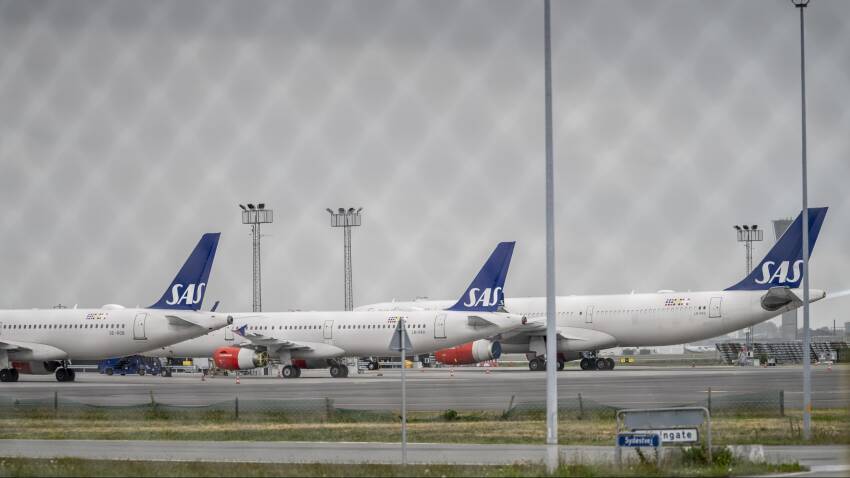
Copenhagen’s Kastrup Airport had expected a drop in business during the coronavirus crisis, but its size was a shock. The airport has seen a 95 percent decline in passengers (DK) in comparison with the same period last year, it reported in a press release. Even though Denmark has now opened its borders for travelers from many countries, the airport expects business to be down around 85 percent for the summer. That means a loss of some 1.5 million tourists and business travelers. The decline affects airlines, hotels and restaurants as well.

This trend puts the airport in a “deep crisis,” says business commentator Ole Krohn from TV2 News: “It will be a couple of years before it is back to the same level from before the coronavirus crisis.” The same forecast applies to other airports in Europe.

Photo: Mads Claus Rasmussen © Scanpix.


Thousands waiting for refunds

Meanwhile, SAS, the largest airline in Scandinavia, is swamped with requests for refunds for canceled flights (DK). According to EU rules, airlines are supposed to refund such tickets within seven days, but with thousands of canceled flights and hundreds of staffers sent home, the company  cannot keep up with the requests. “For almost three months, we have canceled around 800 flights a day,” says John Eckhoff, the company’s press officer. So far, SAS has given refunds to about 700,000 customers, with about one-third opting for a voucher to use on another flight within 12 months.


According to an estimate from Norway, SAS owes customers about DKK 5 billion (USD 770 million), which is more than the DKK 4.3 billion that the Danish state has contributed to the plan to rescue the company from bankruptcy. Norwegian Airlines, the second-largest airline in the region, is in the same position. It has refunded DKK 3.2 billion to customers. 


May miss her father’s funeral

One of the people waiting for a refund is Ingileif Gísladóttir (DK). She had booked five round-trip tickets so that at Easter her family could visit relatives in Iceland, where her father was seriously ill. When the pandemic hit, the flight was canceled, and then to make things worse, her father died on April 7, when her family should have been there with him. Now she is hesitating before buying tickets so that she can attend her father’s funeral because she has no idea when she will receive the refund for the first set of tickets. 


“You must fill out a form that was hard to find - it was like a labyrinth tracking it down,” says Gísladóttir. Then it was hard to get hold of a service representative, who was not very helpful. “I think it was bad, bad service.” When asked whether customers would receive their refunds before the end of the year, SAS’s Eckhoff said that he could not give an estimate.

Stranded at dock
Another overlooked class of people who haven’t been able to travel home to see their families is sailors. One of them was Captain Jens Holstrøm Andersen, who went onboard the Pacific Dragon ship in February, expecting to be at sea for only two months. He had been confined on the ship at harbor in Egypt (DK) and elsewhere indefinitely because no countries would let the crew in. Shipping companies were also reluctant to take new crews onboard because of the risk of infection. Some 400 Danes and perhaps a total of 200,000 sailors in the world are in the same situation, says the Lederne Søfart (Maritime Leaders) organization. Holstrøm Andersen was finally able to return to his family because Denmark gave him status as an “essential worker.”

10 July 2020

Coronavirus DK: Sunny Beachhead for the virus

Even though the coronavirus is well under control in Denmark (as I have written at the start of several posts), there’s always something to be worried about. This week it’s the 150 or so young Danes who have taken to beach resorts in Bulgaria (DK) to party their brains out and who risk bringing the stealthy pathogens back to Denmark. Recently, advertisements by a travel agency for wild dance floors in discotheques at a favorite destination drew the ire of politicians and healthcare researchers for being irresponsible in the coronavirus era. 

“Tired of everything you can’t do in Denmark?” read the ad from DUF travel agency (DK). “At Sunny Beach you can: Party with more than 2,000 other young people. Be at a club all night. Pool party. Boat party.” 

The concerns of the grownups turned out to be justified. The ads were withdrawn, but they had infected their targets. “There are a lot of rules at home now that they don’t have here in the same way,” said one partygoer, Lasse Birch Cassen, “so down here we can really let go like we can’t at home.”

Melting pot of infection

According to the government’s current advisory, travel to Bulgaria, an EU member state, is still permitted. But the country, like the US and some others, is setting records for new infections this week. So the Foreign Ministry is warning travelers to be “extra careful.” Virologist Allan Randrup Thomsen sees a clear parallel to the situation at the ski resorts in Ischgl, Austria, that set off the pandemic in Europe in February: “What we are afraid of is that there is a single superspreader at one of these beach parties and 20-30-40-50 can quickly become infected.”

At places like that, visitors from many countries can create a “melting pot of infection,” says Søren Riis Paludan, another virologist. “The problem is that young people may not show symptoms. . . go under the radar and infect others.” Riis Paludan compares the situation to the one in Florida, where young people were responsible for much of the spread of the infection.

Driven outdoors

After the criticism, the agency changed its tune, “directly recommending that our guests not go to nightclubs” and suggesting instead “the large open-air beach bars,” said managing director Anders Marcuslund.” According to the Bulgarian coronavirus rules, people are to maintain a social distance of 1.5 meters, and if that is not possible, to wear a face mask, which none of the people on the dance floors in the photos seem to be doing.

The Foreign Ministry is following the situation carefully, and officials urge returning travelers to be tested and to isolate themselves until they get a negative test.

Not our fault

On Thursday, the Bulgarian government decided to ban indoor nightclubs (DK) and allow outdoor beach bars to operate at only 50 percent capacity. While some young Danes were annoyed at the restrictions, others didn’t think it would make any difference for them. DUF’s Marcuslund fully endorses the move: “We were of course one step ahead of the Bulgarian authorities.”

When reminded that the guests are still getting drunk, dancing close together, hugging one another and sharing drinks – those “buckets” with several straws in them – Marcuslund maintains that the agency advises people to follow the guidelines but that they are also a “personal responsibility,” concluding, “I don’t think it’s much worse than what you see at home.”


30 June 2020

Coronavirus DK: Confusion over testing policies at the border

Several political parties are criticizing the government for not following stricter policies for travelers (DK) arriving in Denmark. They say that all people from countries with a high infection rate should present a recent negative test for the coronavirus or be tested on arrival. The current practice is inconsistent and insufficient, they maintain. Some arrivals from so-called “quarantine countries” with a “worthy purpose,” such as a job interview, must present a negative test. In other cases, people attending a funeral or a business meeting, for example, can enter freely. It is optional whether they submit to a test on arrival.


Are the testing facilities even being used?

Testing facilities were set up at Kastrup Airport in Copenhagen on June 15. Since then, some 25,000 people have entered Denmark there, but the number who have presented tests or have been tested is unknown. “We have said that Danes must comply with guidelines,” says Peter Skaarup of the Danish People’s Party. “And then we see, for example, a flight from Islamabad that brought a large number of infected people to Denmark.” Arrivals from high-risk countries should also be quarantined, added Skaarup.

Other parties agree that the current policy is not effective. Although testing is available at the airport, the facility is not prominent. All arrivals should be met by a test team that offers them a test, says Kirsten Normann Andersen, health care spokesperson for the Socialist People’s Party. They should be isolated until we know they aren’t infected, continues Normann Andersen, and that includes all travelers from other EU countries.


One test is not enough

But according to virologist Allan Randrup Thomsen, a negative test is no guarantee that one is free of infection. Tests may not be reliable in the country of origin, and one can become infected after testing negative. “To be certain, people should actually be tested twice at a few days’ interval,” says Randrup Thomsen. “And during that time they should be isolated, if this system is to function optimally.” Randrup Thomsen doesn’t think it is worthwhile to test travelers from all EU countries, however. If the infection rate is below the limit of 20 per 10,000, then the testing would involve much work and identify very few cases. The tests also produce some false positives.

Rasmus Horn Langhoff, health care spokesperson for the governing Social Democratic Party, agrees “with the intention to ensure that we protect Denmark from the coronavirus as well as possible. . . . I’m sure that we can do it better than we do today. And we very much want to look into this.”


Swedes sail to Denmark in vain

The confusion was no more evident than regarding the new regulations for arrivals from neighboring Sweden (DK). The country, which has followed a singularly laissez-faire policy regarding the coronavirus, has about the highest infection rate in the EU. It is one of the EU six countries that Danes are not allowed to travel to. There is an exception, however, for three regions in southern Sweden close to Denmark. Even residents of these quarantine regions are subject to certain requirements, however. If they do not have a valid purpose, such as work or family in Denmark, they must present a negative coronavirus test taken within the previous 72 hours. 

The Swedish media and a ferry company announced incorrectly that a negative test was not required, and the Danish police that manage border control at the ferry terminal in Helsingør had also received incorrect information at first. This led to chaos at the border as many Swedes on the ferry were turned away (DK) and had to sail back to Sweden. The ferry company, Sundbusserne, which had waited three months during the lockdown before opening the route, announced that it was canceling the route again.

29 June 2020

Coronavirus DK: Summer traffic, youth programs, test milestone

Saturday was the start of the summer vacation period in Denmark. Schools had just closed for the summer, and the government approved travel to most EU countries. It was also skiftedag (changing-day) at summer house resort regions, the day of the week when  rentals start – last week’s renters leave and the new week’s arrive.

There was traffic advisory for the highways (DK) because many people have chosen to spend their vacation in Denmark and others are heading to Germany, one of the original three countries approved for summer travel. They’re driving because the destinations are close and there’s less risk of infection in comparison with sitting on a plane and passing through crowded airports. So they encountered lines on the main roads out of Copenhagen and at the German border.

Here you can read the official rules and guidelines for travelers entering Denmark (in English).


More soldiers and students

The Danish military services (DK) have increased the number of recruits they will take this year and next in order to give opportunities to young people who are not able to pursue other plans. After high school, many young Danes take a gap year to travel or study abroad, and this year they aren’t able to. Youth unemployment always rises in times of crisis, and it is important to help young people get a good start in life, said Defense Minister Trine Bramsen: “Training in the Defense Forces opens doors in life, and therefore I think we should contribute to the current challenge.” 

The number of additional spots is only about 150; it is limited by the availability of training facilities and instructors. Last year there was a total of about 5,000 recruits in the Defense Forces and the Emergency Management Agency. Earlier, Danish universities announced that they were adding 5,000 spots in technical and health care programs in order to accommodate young people who have trouble finding work during the recession.


More tests

More than 1 million tests (DK) for the coronavirus have now been performed in Denmark. In the beginning of the outbreak, people with symptoms were encouraged simply to self-quarantine, but after pressure from the WHO and others, the Health Authority stepped up its testing program significantly. It set up temporary tents in several cities and offered tests to anyone who suspected they had been exposed to the virus in an effort to gain a more complete idea of the extent of the infection.

The 1-million figure doesn’t mean that 1 million people have been tested, though, because some have been tested more than once. Around 800,000 people have been tested out of the population of 5.8 million. The testing has identified 12,675 cases, and the number of hospitalized patients has fallen to a mere 31.


More protest infections

One of the recent findings of the testing program is the infections stemming from the Black Lives Matter (DK) demonstration on June 7. The event caused concern because it was attended by some 15,000 people, many of them standing close together and chanting and few of them wearing masks. The number of new infections identified from the demonstration has remained low, however. It has now risen to 10 or 12, although it is unknown how many who attended have been tested. 

27 June 2020

Coronavirus DK: EU border patrol – who’s safe and who’s not

The Danish Ministry of Foreign Affairs announced the first set of European countries that Danes can travel to (DK) as of today, June 27. It consists of 25 countries, a large majority of the EU. Excluded are only Romania, Portugal, the UK, Ireland, Malta and Sweden. “Today’s relaxation of the travel advisory shows that both Denmark and most of Europe are in much better condition than we dared hope only a short time ago,” said Jeppe Kofod, Minister of Foreign Affairs.


Frequent updates

The main criterion for allowing travel to a country is that the infection rate is under 20 per 100,000 inhabitants in the preceding week. The list will be updated every Thursday. If a country exceeds the limit while Danes are staying there, travelers are urged to return to Denmark and be tested for the coronavirus. Citizens of these countries may also travel to Denmark if they have reservations for at least six days. Certain regions of the countries may have significantly higher infections than the national average, and SSI, the agency responsible for preparedness against infectious diseases, will maintain a separate list of them.


Regional outbreaks 

This comes at a time when Europe has seen an increase in cases for the first time in the weeks since most of the countries began to relax their lockdown measures. About 20,000 new cases and 700 new deaths are being recorded daily. According to Dr. Hans Henri Kluge, European Regional Director of the WHO, “30 countries have seen an increase in new cumulative cases over the past two weeks. In 11 of these countries, accelerated transmission has led to very significant resurgence.” 

The reproduction rate in Germany (DK), for example, has recently risen from 1.06 to 1.79, and a large outbreak at a slaughterhouse in the Gütersloh region necessitated the resumption of strict lockdown measures. The WHO’s European Region, however, is a much larger area than is covered in Denmark’s travel advisory. It comprises 54 countries and extends to the Middle East and central Asia. Kluge expects the resurgence to subside during the summer but warns that the situation could worsen in the fall, when seasonal influenza and pneumonia return.


Yankee, stay home!

The EU is also preparing its list of countries where the pandemic is so widespread that their citizens will not be welcome when it reopens its external borders on July 1. Along with other disaster cases such as Brazil and Russia and several developing nations, the United States has attained the distinction of being considered too risky. The list is not final yet, but it appears that the EU is prepared to forego the substantial tourism and business travel from America in order to uphold its standard. The benchmark is the average number of new infections per 100,000 inhabitants, which is also used for the Danish travel advisory. The figure for the EU as a whole now stands at 16. The level in the US is 107.


See Denmark first 

The Danish rejsepas (travel passport) was sold out (DK) on Friday morning. All 50,000 passes that went on sale three days before are gone, as many Danes have chosen to hold their summer vacation in Denmark this year and to use collective traffic. The card gives access to all train, bus, metro and light rail in Denmark for an 8-day period from July 27 to August 9.


23 June 2020

Coronavirus DK: German summer exchange program

Many Danes are following the Health Authority’s travel guidelines (DK) and avoiding summer trips to southern Europe. The Ausfahrt travel agency, which sells drive-yourself vacations in Germany, has seen a large demand since June 15, when the government opened the borders to three countries. Of them, Germany is the most convenient for road trips. People are choosing out-of-the-way destinations over large cities in order to minimize the risk of infection from mixing with crowds and standing in lines. 

And that is sensible, according to healthcare researchers. “Traveling by plane and passing through airports poses high risks,” says experimental virologist Allan Randrup Thomsen. “It’s better to travel in your own car, where you have your own little cabin.”


Financially safer too

It also has financial advantages, says Vagn Jelsøe of the Danish Consumer Council. “The safest is a car trip with hotel reservations that you pay for after each night.” That is because if you buy a plane ticket or make a hotel reservation in advance, you may have to cancel them if the pandemic becomes worse in the country and travel there is prohibited again. If the airline doesn’t cancel the flight, you won’t get a refund. Another solution is a package trip from an agency that offers cancellation insurance, adds Jelsøe, but you must make sure that the terms and conditions are clear.

After the border to Germany opened, the government announced that travel would be allowed to additional European countries beginning on June 27, but some people have chosen not to travel abroad at all this year. Reservations at Danish summer houses have risen. “The situation is unstable,” says Randrup Thomsen, “and you cannot plan a trip many months in advance.


The feeling is mutual

Germans are also showing great interest (DK) in visiting Denmark this summer. There were long lines of cars at the border on the day it opened because travelers must show documentation for their reservations. Retail businesses in southern Jutland also report a large turnout. “There are actually more people than there were at the same time last year,” says Thomas Hansen, the manager of a supermarket in Søndervig. “That is probably because we are not traveling out in the world. Our German guests have just waited until they could come to Denmark.”

“Our reservations are five times higher than normal,” says Ivan Kern Andersen, owner of Dråby Strand Camping. Like the summer houses on the west coast of Jutland, the camp grounds have had an above-average number of Danish visitors in the spring, but they could not make up for loss of business from Germans. The number of tourists is expected to increase further when schools go on vacation. “They say they have missed us,” says Thomas Hansen.


Subsidy for biking and hiking

The government is also trying other measures to increase travel in Denmark. In the month of July, it is proposing to make ferry trips between Danish islands free of charge (DK) for people traveling by bicycle and on foot. “This crisis has been hard. Not least for the peripheral regions in Denmark,” says Simon Kollerup, Minister of Business Affairs, who wants to “support the economy, which is more vulnerable on the small islands.” 

The ferry companies and regions with many ferry routes such as southern Funen welcome the plan, but the opposition parliamentary parties do not consider it a serious remedy that will restore jobs in the tourism industry. “A Band-Aid on an open fracture,” said Troels Lund Poulsen, the financial spokesperson for the Liberal Party.

21 June 2020

Coronavirus DK: Opening for travel in Europe

The government has changed its policy on foreign travel. “I understand very well that there are Danes who in the months we have been through have a desire for a clarification regarding incoming and outgoing travel,” said Jeppe Kofod, Minister of Foreign Affairs, who presented the new plan along with Minister of Justice Nick Hækkerup.

Objective criteria

Beginning on June 27, the government will allow travel between Denmark and EU countries (DK), the Schengen Area and the UK on the basis of objective criteria. The most important measure is the infection rate in a country. Other criteria concerning the number of tests will be determined later. The limit is 20 infections per 100,000 inhabitants per week. Countries with fewer infections than that will be designated as “Open.” Countries with 20 to 30 infections per 100,000 will be designated as a “Quarantine Country, ”and those with more than 30 infections will be closed.

SSI, the agency for preparedness against infectious diseases, will update the list every week, and if the infection rate rises in a country, its status can be altered. Currently, all European countries except Portugal and Sweden qualify for Open status. Foreign tourists entering will still need to book a reservation for at least six days, except for people who live in border regions such as Schleswig-Holstein, Germany. Tourists from a Quarantine Country must present negative coronavirus test results from within the preceding 72 hours.

Regional exceptions

Special conditions apply to Nordic countries. If a region has an infection rate below the limit, travel will be permitted. This is especially pertinent for the the Skåne region in southern Sweden. Swedish officials have been complaining that its citizens were not given access to Denmark like its other neighboring countries, Germany and Norway. Unnecessary travel outside of Europe is still strongly discouraged, and there are no plans to change that advisory.

Laissez-faire Sweden is the outlier

The list of registered cases is based on data from Johns Hopkins University. For the week ending June 17, it shows that Sweden had 75 cases per 100,000, Portugal had 20.2, the UK had 13.7, and all others had fewer than 10. The level in Denmark was 4.8, which was slightly higher than that of France and Italy and slightly lower than in Spain.

Opposition and tourism industry still dissatisfied

Several other parliamentary parties have been pressuring the government (DK) to relax the travel restrictions. “This is a step in the right direction,” said Jakob Ellemann-Jensen, chairperson of the Liberal Party. But these parties are still unhappy that travel outside of Europe is not permitted. Recently the SAS and Norwegian airlines announced that they would reopen a number of international routes on July 1. The parties also find the six-day reservation requirement arbitrary. “It is completely destroying the hotel industry,” said Søren Pape Poulsen, the chairperson of the Conservative Party.

If we let everyone in, answered Hækkerup, “we would risk importing infection chains and be forced to roll back the reopening.”

18 June 2020

Coronavirus DK: Opinion surveys on risky travel and racism


A survey made by YouGov for the B.T. tabloid shows that a certain number of people are disregarding the travel restrictions (DK) set forth by the government and Health Authority. According to the advisory, before the borders to three countries opened on June 15 Danes were to avoid unnecessary travel and if they did travel, they were to undergo 14 days’ quarantine after they returned. The ban covered neighboring Sweden, where many Danes have summer houses. 

In the survey made on June 5 of 1,255 persons representative of the Danish population, some 4 percent responded that they had traveled abroad in the past month, and of those, 45 percent said that they had not quarantined themselves afterward. If the figures are extrapolated to reflect the entire country, they correspond to 8,400 adults who, after being abroad, returned to their workplace and frequented supermarkets and restaurants without first undergoing quarantine. According to Allan Randrup Thomsen, Professor of Virology at University of Copenhagen, it is very likely that there is a superspreader among that number. “It is thoughtless and inconsiderate that they do not comply with the rules that we are all subject to.”


More tabloid readers will flout advisory

In a separate survey of the newspaper’s 55,000 readers, 11 percent of them said that they intended to take a vacation in a country that the government has forbidden because of the risk of infection. Thomsen warns against the risk of the infection spreading from hotspots where many tourists gather and reminds us that in March relatively few skiing tourists from a small area in northern Italy and Austria were responsible for spreading the virus throughout Western Europe. It is possible that B.T.’s readers are less likely to comply with recommendations than those of some other newspapers, but it is also possible that they are more representative of the Danish population.

Since June 15, people in Denmark may travel to three countries – Germany, Norway and Iceland – without undergoing quarantine afterward. If you travel to other countries, it is not against the law not to quarantine yourself, but your employer may require you to do so. And if an employer forbids employees to travel to other countries beforehand, you can be fired for doing so.


News flash: Danes don’t think they’re racists

Another poll indicated that just over half of Danes do not think that racism is a problem (DK) in Denmark. Some 51 percent answered that they disagreed either completely or to a great degree with the statement that racism is a widespread problem in the country. Some 32 percent agreed completely or to a great degree. The breakdown among various demographic segments was not surprising. A larger percentage of younger respondents, aged 18-29, say it is a problem, as do people who vote for left-wing parties, with the exception of the center-left Social Democrats. A large majority of voters for the other parties do not believe it is a problem. The survey was made after the demonstration against racism and police brutality that was held in Copenhagen on June 7. 

The results do not surprise Mira Skadegaard, a postdoc researcher at the Institute for Culture and Learning at Aalborg University. Most people in Denmark do not experience racism since by definition it is a minority of the population that is subject to discrimination, says Skadegaard. But there is now a greater awareness that racism exists, she continues, and that is positive because previously we have not talked about it much and have been in denial about it.


Racial or ethnic discrimination?

One possible problem with the survey may be that it does not capture opinions about the views on ethnic and religious minorities. Racial minorities in Denmark are very small, and issues involving discrimination have concerned mainly Muslims and immigrants from the Middle East, most of whom are not black. 

31 May 2020

Coronavirus DK: Winners and losers from the new border policy

On Friday Prime Minister Mette Frederiksen announced that on June 15, Denmark would allow tourists from Germany, Norway and Iceland to visit Denmark as long as they stayed at least six nights outside of Copenhagen. Danes likewise could travel to these three countries and were advised to avoid large cities. The plan drew criticism from the opposition parliamentary parties and the Copenhagen tourism industry. The reactions continued yesterday.

Summerhouse rental agencies in Jutland (DK) were suddenly overwhelmed with bookings from both Germans and Danes. Meanwhile, tourism officials in Copenhagen tried to tote up the damage to the capital because of the ban on overnight stays. Mikkel Aarø-Hansen, the managing director of Wonderful Copenhagen, estimates that it will cost the city DKK 1.3 billion in revenue ($185 million) and will affect 1,400 jobs. That comes on top of a loss of DKK 4.25 billion ($600 million) already in the three months since the lockdown began.


Some healthcare researchers approve

“If you want to avoid people crowding together in the evening – since that is the situation we have seen in superspreader events,” says Jens Lundgren, Professor of Infectious Disease Medicine, “there is a good argument on healthcare grounds (DK) for not allowing tourists to stay overnight in the city.” Allan Randrup Thomsen, Professor of Virology, agrees: On a nice day, you see many people out at Nyhavn and Strøget (the main pedestrian street). You have to add tourists to them. Copenhagen has been the hotspot, and you don’t want to make it a larger one.


Danes must stick to the countryside

Danes also began to make vacation plans according to the restrictions (DK) on their travel to the three countries. Those who visit a city with more than 750,000 inhabitants must self-isolate for 14 days after returning. That limitation is irrelevant for Norway and Iceland, where there are no cities of that size, but it affects five cities in Germany, including Berlin and Munich. This is a travel advisory, not an absolute prohibition, says Erik Brøgger Rasmussen of the Ministry of Foreign Affairs. “There will be no control of where people have been by the police at the airport. . . . But we expect that Danes will listen to the advice and guidelines as they have done throughout the coronavirus crisis.”

Danish tourists are also advised to follow the local guidelines on precautions when they travel. For example, in Germany people must cover their mouths and noses with masks or scarves when they enter shops and use public transportation, but in Norway there is no requirement on wearing a mask. The rules and recommendations may also vary from locality to locality within the countries, for example the limit on gatherings.


Swedish annoyance

In Sweden, the reaction (DK) to the country’s exclusion from the border policy met disappointment, as expected. Niels Paarup Petersen, a Danish-born member of the Swedish parliament, called it “a little hypocritical” that Denmark cannot tolerate its neighbors from Skåne (the southern region of Sweden), which has not been hurt badly by the pandemic. “Many Danes are running around in Skåne, and it is apparently not dangerous. But if some people from Skåne come to Denmark, it is dangerous.”

By far the greatest number of infections in Sweden, which has not ordered a strict lockdown, have occurred in Stockholm. The infection rate is actually lower in Skåne than in Zealand, the island where Copenhagen is located, says Mikael Damberg, Swedish Minister for the Interior. The Swedish Foreign Minister, Ann Linde, says that the country had hoped for a joint Nordic solution and is continuing its dialogue with the other countries in the region.

At the same time, the Swedish Minister for Social Affairs, Lena Hallengren, acknowledged that the country is still in the midst of the crisis (DK). The number of deaths rose to 4,395, in contrast to 571 in Denmark. Anders Tegnell, the state epidemiologist who designed the laissez faire policy, admitted that it was a mistake not to test skiers who returned from Ischghl, the Austrian hotspot.

10 May 2020

Coronavirus DK: Not so fast – it’s not over yet

After being closed for about two months, shopping centers are preparing to open (DK) tomorrow. They are setting up signs explaining the rules of conduct and bottles of hand sanitizer. They are closing lounges and children’s playrooms. Security guards and customer counters will be posted at the doors to make sure that customers maintain a distance from one another. Vibeke Qvist, the head of the Frederiksberg Center Association in Copenhagen, does not expect a large number of customers at first, but she and the shop owners are happy to get started again. 

The government does not want people to think that the lockdown is over and to let things get out of control, however. Along with the resumption of some activities in phase 2, it is also issuing a formal prohibition against activities (DK) that have not yet been approved for reopening. The ban will be enforced by the police, and violations will be subject to penalties, says Minister of Justice Nick Hækkerup. Certain zoos and museums have raised the possibility of opening before they are scheduled to in phase 3 on June 8. Thus far, there has been no official prohibition, and that has led to some confusion at times, for example when a cabinet minister informally disapproved of IKEA’s reopening although it was perfectly legal. Hækkerup sympathizes with organizations that must wait longer to open, but explains that prioritization is necessary in order to maintain control of the spread of the infections.


No jumping the gun

To remind people of the timetable, the police are tweeting about enforcing violations. Yesterday evening in Jutland, two restaurants were charged (DK) with serving food and drinks at outdoor tables. Restaurants and cafes are not scheduled to reopen until May 18. In another Jutland town, 14 people were caught congregating (DK) in a parking lot. Four got away, but ten were charged with exceeding the limit on gatherings.

The Ministry of Foreign Affairs extended its advisory against unnecessary foreign travel (DK) until May 31. Jeppe Kofod, the Minister of Foreign Affairs, says that he understands people want to travel and are worried about their summer vacation plans but that conditions under the pandemic do not permit free travel yet. Airlines’ business has suffered greatly during the crisis. In April, the number of passengers on SAS flights fell 95 percent from the level in 2019.


Infections falling despite reopening

SSI, the agency responsible for preparedness against infectious diseases, reported a decline in the reproduction rate (DK), or R0, which measures the average number of people infected by an infected person, despite the first relaxations of the lockdown restrictions. The announcement, which was made in an email response to the Ritzau agency, did not specify the latest measurement. The rate had fallen to 0.6 in mid-April and then, after the first phase of the reopening, had risen back to 0.9 on April 30. The rate is used in the government’s decisions about the relaxation of pandemic restrictions. The SSI cautioned that it is subject to a margin of error and that a new measurement would be made in the coming week.


The wonders of socialism

Readers have referred me to a Friday NY Times column by Nicholas Kristof, “McDonald’s Workers in Denmark Pity Us.” Kristof gives a good overview of the advantages of Denmark’s social democracy, which is derided by some American politicians as “socialism” even while conditions in the US labor market during the pandemic deteriorate at an alarming  pace.